WGXC-FM


WGXC-90.7-FM Community Calendar

The Community Calendar gathers upcoming events in the Hudson Valley, Catskills, and Capital Region. Add your event to be posted here, and hear these activities read on the radio by WGXC programmers!

For internal use only. Your email will not be published.

"08:30 AM", for example, or "10:01 PM". Leave this blank if it's an all-day event.

Same format as start time.

ONGOING

Saturday

Dec

25

ONGOING EVENTS

WGXC's 10th Anniversary Year

Feb 01, 2021 - Dec 31, 2021

Wave Farm Radio Artist Fellowship: Andy Stuhl

Sep 01, 2021 - May 31, 2022

Short Waves / Long Distance Open Call 2022

Dec 03, 2021 - Jan 31, 2022

ONGOING

Sunday

Dec

26

ONGOING EVENTS

WGXC's 10th Anniversary Year

Feb 01, 2021 - Dec 31, 2021

Wave Farm Radio Artist Fellowship: Andy Stuhl

Sep 01, 2021 - May 31, 2022

Short Waves / Long Distance Open Call 2022

Dec 03, 2021 - Jan 31, 2022

ONGOING

Monday

Dec

27

ONGOING EVENTS

WGXC's 10th Anniversary Year

Feb 01, 2021 - Dec 31, 2021

Wave Farm Radio Artist Fellowship: Andy Stuhl

Sep 01, 2021 - May 31, 2022

Short Waves / Long Distance Open Call 2022

Dec 03, 2021 - Jan 31, 2022

Tuesday

Dec

28

Club Helsinki Virtual Open Mic Show

Dec 28, 2021: 7pm- 8pm

Every Tuesday Night Cameron Melville and Ryder Cooley host a Virtual Open Mic Night featuring music, poetry, comedy, interviews, performance art and more! This will be streaming live on the Club Helsi...

ONGOING

Tuesday

Dec

28

ONGOING EVENTS

WGXC's 10th Anniversary Year

Feb 01, 2021 - Dec 31, 2021

Wave Farm Radio Artist Fellowship: Andy Stuhl

Sep 01, 2021 - May 31, 2022

Short Waves / Long Distance Open Call 2022

Dec 03, 2021 - Jan 31, 2022

ONGOING

Wednesday

Dec

29

ONGOING EVENTS

WGXC's 10th Anniversary Year

Feb 01, 2021 - Dec 31, 2021

Wave Farm Radio Artist Fellowship: Andy Stuhl

Sep 01, 2021 - May 31, 2022

Short Waves / Long Distance Open Call 2022

Dec 03, 2021 - Jan 31, 2022

ONGOING

Thursday

Dec

30

ONGOING EVENTS

WGXC's 10th Anniversary Year

Feb 01, 2021 - Dec 31, 2021

Wave Farm Radio Artist Fellowship: Andy Stuhl

Sep 01, 2021 - May 31, 2022

Short Waves / Long Distance Open Call 2022

Dec 03, 2021 - Jan 31, 2022

ONGOING

Friday

Dec

31

ONGOING EVENTS

WGXC's 10th Anniversary Year

Feb 01, 2021 - Dec 31, 2021

Wave Farm Radio Artist Fellowship: Andy Stuhl

Sep 01, 2021 - May 31, 2022

Short Waves / Long Distance Open Call 2022

Dec 03, 2021 - Jan 31, 2022

ONGOING

Saturday

Jan

01

ONGOING EVENTS

Wave Farm Radio Artist Fellowship: Andy Stuhl

Sep 01, 2021 - May 31, 2022

Short Waves / Long Distance Open Call 2022

Dec 03, 2021 - Jan 31, 2022

ONGOING

Sunday

Jan

02

ONGOING EVENTS

Wave Farm Radio Artist Fellowship: Andy Stuhl

Sep 01, 2021 - May 31, 2022

Short Waves / Long Distance Open Call 2022

Dec 03, 2021 - Jan 31, 2022

ONGOING

Monday

Jan

03

ONGOING EVENTS

Wave Farm Radio Artist Fellowship: Andy Stuhl

Sep 01, 2021 - May 31, 2022

Short Waves / Long Distance Open Call 2022

Dec 03, 2021 - Jan 31, 2022

ONGOING

Tuesday

Jan

04

ONGOING EVENTS

Wave Farm Radio Artist Fellowship: Andy Stuhl

Sep 01, 2021 - May 31, 2022

Short Waves / Long Distance Open Call 2022

Dec 03, 2021 - Jan 31, 2022

ONGOING

Wednesday

Jan

05

ONGOING EVENTS

Wave Farm Radio Artist Fellowship: Andy Stuhl

Sep 01, 2021 - May 31, 2022

Short Waves / Long Distance Open Call 2022

Dec 03, 2021 - Jan 31, 2022

ONGOING

Thursday

Jan

06

ONGOING EVENTS

Wave Farm Radio Artist Fellowship: Andy Stuhl

Sep 01, 2021 - May 31, 2022

Short Waves / Long Distance Open Call 2022

Dec 03, 2021 - Jan 31, 2022

ONGOING

Friday

Jan

07

ONGOING EVENTS

Wave Farm Radio Artist Fellowship: Andy Stuhl

Sep 01, 2021 - May 31, 2022

Short Waves / Long Distance Open Call 2022

Dec 03, 2021 - Jan 31, 2022

Saturday

Jan

08

Sheffield Winter Farmers' Market

Jan 08, 2022: 10am- 1pm
Dewey Hall

91 Main St. | Sheffield, Massachusetts 01257
http://deweyhall.com/

The Sheffield Farmers’ Market is holding a winter market with local produce, meats, baked goods, crafts and gifts, and live music. We will continue to offer our SNAP Match program just as we do for t...

ONGOING

Saturday

Jan

08

ONGOING EVENTS

Wave Farm Radio Artist Fellowship: Andy Stuhl

Sep 01, 2021 - May 31, 2022

Short Waves / Long Distance Open Call 2022

Dec 03, 2021 - Jan 31, 2022

ONGOING

Sunday

Jan

09

ONGOING EVENTS

Wave Farm Radio Artist Fellowship: Andy Stuhl

Sep 01, 2021 - May 31, 2022

Short Waves / Long Distance Open Call 2022

Dec 03, 2021 - Jan 31, 2022

ONGOING

Monday

Jan

10

ONGOING EVENTS

Wave Farm Radio Artist Fellowship: Andy Stuhl

Sep 01, 2021 - May 31, 2022

Short Waves / Long Distance Open Call 2022

Dec 03, 2021 - Jan 31, 2022

ONGOING

Tuesday

Jan

11

ONGOING EVENTS

Wave Farm Radio Artist Fellowship: Andy Stuhl

Sep 01, 2021 - May 31, 2022

Short Waves / Long Distance Open Call 2022

Dec 03, 2021 - Jan 31, 2022

ONGOING

Wednesday

Jan

12

ONGOING EVENTS

Wave Farm Radio Artist Fellowship: Andy Stuhl

Sep 01, 2021 - May 31, 2022

Short Waves / Long Distance Open Call 2022

Dec 03, 2021 - Jan 31, 2022

ONGOING

Thursday

Jan

13

ONGOING EVENTS

Wave Farm Radio Artist Fellowship: Andy Stuhl

Sep 01, 2021 - May 31, 2022

Short Waves / Long Distance Open Call 2022

Dec 03, 2021 - Jan 31, 2022

ONGOING

Friday

Jan

14

ONGOING EVENTS

Wave Farm Radio Artist Fellowship: Andy Stuhl

Sep 01, 2021 - May 31, 2022

Short Waves / Long Distance Open Call 2022

Dec 03, 2021 - Jan 31, 2022

Saturday

Jan

15

Weird Science with Professor Sparks

Jan 15, 2022: 10:30 am- 12pm
FASNY Museum of Firefighting

117 Harry Howard Ave. | Hudson, NY 12534 | 518-822-1875
http://www.fasnyfiremuseum.com/

The FASNY Museum of Firefighting hosts Professor Sparks.

ONGOING

Saturday

Jan

15

ONGOING EVENTS

Wave Farm Radio Artist Fellowship: Andy Stuhl

Sep 01, 2021 - May 31, 2022

Short Waves / Long Distance Open Call 2022

Dec 03, 2021 - Jan 31, 2022

ONGOING

Sunday

Jan

16

ONGOING EVENTS

Wave Farm Radio Artist Fellowship: Andy Stuhl

Sep 01, 2021 - May 31, 2022

Short Waves / Long Distance Open Call 2022

Dec 03, 2021 - Jan 31, 2022

Monday

Jan

17

MLK Jr. Day Rally

Jan 17, 2022: 10:30 am- 12:30 pm

Please Join us for a very special MLK Birthday Holiday Observance which will include a 11 a.m. Motorcade preceding the Rally. Vehicle Line up 10:30 a.m. at Columbia and N. 6th Street parking lot. At t...

ONGOING

Monday

Jan

17

ONGOING EVENTS

Wave Farm Radio Artist Fellowship: Andy Stuhl

Sep 01, 2021 - May 31, 2022

Short Waves / Long Distance Open Call 2022

Dec 03, 2021 - Jan 31, 2022

ONGOING

Tuesday

Jan

18

ONGOING EVENTS

Wave Farm Radio Artist Fellowship: Andy Stuhl

Sep 01, 2021 - May 31, 2022

Short Waves / Long Distance Open Call 2022

Dec 03, 2021 - Jan 31, 2022

Wednesday

Jan

19

Catskill Library Board meeting

Jan 19, 2022: 6:45 pm- 8pm
Catskill Public Library

1 Franklin St. | Catskill, NY
http://www.catskillpubliclibrary.org/

Catskill Public Library, Palenville Branch

3335 Route 23A | Palenville, NY 12463 | 518-678-3357
http://catskillpubliclibrary.org/

Regular monthly meeting of the Catskill Library Board of Trustees. The meetings are held at either the Catskill Library or the Palenville Branch Library. The meetings are subject to change, so please...

ONGOING

Wednesday

Jan

19

ONGOING EVENTS

Wave Farm Radio Artist Fellowship: Andy Stuhl

Sep 01, 2021 - May 31, 2022

Short Waves / Long Distance Open Call 2022

Dec 03, 2021 - Jan 31, 2022

ONGOING

Thursday

Jan

20

ONGOING EVENTS

Wave Farm Radio Artist Fellowship: Andy Stuhl

Sep 01, 2021 - May 31, 2022

Short Waves / Long Distance Open Call 2022

Dec 03, 2021 - Jan 31, 2022

ONGOING

Friday

Jan

21

ONGOING EVENTS

Wave Farm Radio Artist Fellowship: Andy Stuhl

Sep 01, 2021 - May 31, 2022

Short Waves / Long Distance Open Call 2022

Dec 03, 2021 - Jan 31, 2022

ONGOING

Saturday

Jan

22

ONGOING EVENTS

Wave Farm Radio Artist Fellowship: Andy Stuhl

Sep 01, 2021 - May 31, 2022

Short Waves / Long Distance Open Call 2022

Dec 03, 2021 - Jan 31, 2022

ONGOING

Sunday

Jan

23

ONGOING EVENTS

Wave Farm Radio Artist Fellowship: Andy Stuhl

Sep 01, 2021 - May 31, 2022

Short Waves / Long Distance Open Call 2022

Dec 03, 2021 - Jan 31, 2022

ONGOING

Monday

Jan

24

ONGOING EVENTS

Wave Farm Radio Artist Fellowship: Andy Stuhl

Sep 01, 2021 - May 31, 2022

Short Waves / Long Distance Open Call 2022

Dec 03, 2021 - Jan 31, 2022

ONGOING

Tuesday

Jan

25

ONGOING EVENTS

Wave Farm Radio Artist Fellowship: Andy Stuhl

Sep 01, 2021 - May 31, 2022

Short Waves / Long Distance Open Call 2022

Dec 03, 2021 - Jan 31, 2022

ONGOING

Wednesday

Jan

26

ONGOING EVENTS

Wave Farm Radio Artist Fellowship: Andy Stuhl

Sep 01, 2021 - May 31, 2022

Short Waves / Long Distance Open Call 2022

Dec 03, 2021 - Jan 31, 2022

ONGOING

Thursday

Jan

27

ONGOING EVENTS

Wave Farm Radio Artist Fellowship: Andy Stuhl

Sep 01, 2021 - May 31, 2022

Short Waves / Long Distance Open Call 2022

Dec 03, 2021 - Jan 31, 2022

ONGOING

Friday

Jan

28

ONGOING EVENTS

Wave Farm Radio Artist Fellowship: Andy Stuhl

Sep 01, 2021 - May 31, 2022

Short Waves / Long Distance Open Call 2022

Dec 03, 2021 - Jan 31, 2022

ONGOING

Saturday

Jan

29

ONGOING EVENTS

Wave Farm Radio Artist Fellowship: Andy Stuhl

Sep 01, 2021 - May 31, 2022

Short Waves / Long Distance Open Call 2022

Dec 03, 2021 - Jan 31, 2022

ONGOING

Sunday

Jan

30

ONGOING EVENTS

Wave Farm Radio Artist Fellowship: Andy Stuhl

Sep 01, 2021 - May 31, 2022

Short Waves / Long Distance Open Call 2022

Dec 03, 2021 - Jan 31, 2022

ONGOING

Monday

Jan

31

ONGOING EVENTS

Wave Farm Radio Artist Fellowship: Andy Stuhl

Sep 01, 2021 - May 31, 2022

Short Waves / Long Distance Open Call 2022

Dec 03, 2021 - Jan 31, 2022

ONGOING

Tuesday

Feb

01

ONGOING EVENTS

Wave Farm Radio Artist Fellowship: Andy Stuhl

Sep 01, 2021 - May 31, 2022

ONGOING

Wednesday

Feb

02

ONGOING EVENTS

Wave Farm Radio Artist Fellowship: Andy Stuhl

Sep 01, 2021 - May 31, 2022

ONGOING

Thursday

Feb

03

ONGOING EVENTS

Wave Farm Radio Artist Fellowship: Andy Stuhl

Sep 01, 2021 - May 31, 2022

ONGOING

Friday

Feb

04

ONGOING EVENTS

Wave Farm Radio Artist Fellowship: Andy Stuhl

Sep 01, 2021 - May 31, 2022

ONGOING

Saturday

Feb

05

ONGOING EVENTS

Wave Farm Radio Artist Fellowship: Andy Stuhl

Sep 01, 2021 - May 31, 2022

ONGOING

Sunday

Feb

06

ONGOING EVENTS

Wave Farm Radio Artist Fellowship: Andy Stuhl

Sep 01, 2021 - May 31, 2022

Monday

Feb

07

Radio Deprogramming Workshop with Andy Stuhl

Feb 07, 2022 - Feb 28, 2022

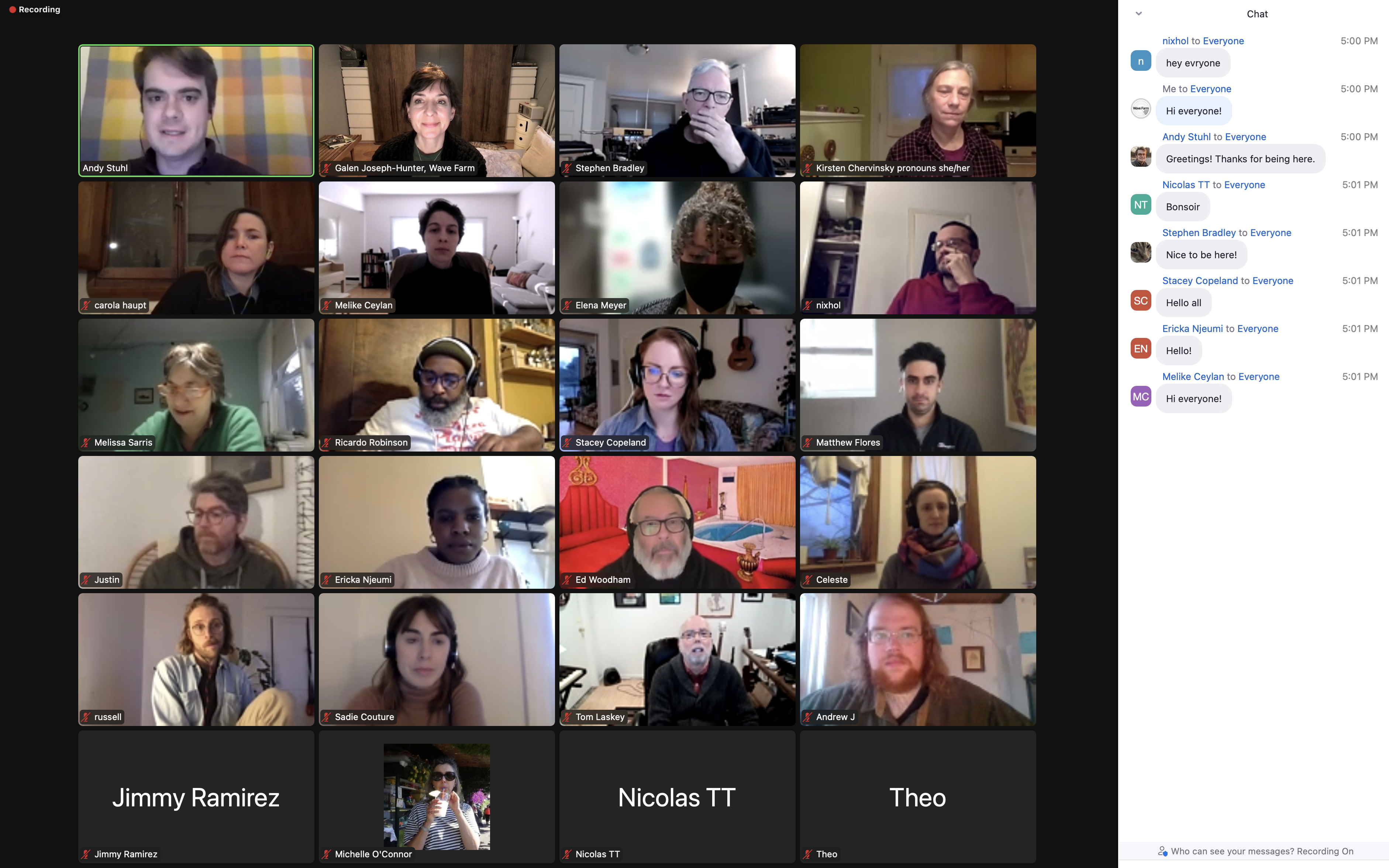
What is the nature of the programming that radio programmers do? How did radio practices take shape early on under the idea that it was a programmable medium? What does the work of broadcast programmi...

invert an aspect of its usual functioning.


Deprogramming: micro-interventions for media-makers

These short text prompts, along with their audio and video interpretations, are the products of our collaborative imagining in the Radio Deprogramming workshop. Deprogramming, we decided, can mean many things: disrupting routines, inverting diagrams, restoring relations to space, rupturing the ordinary, transporting while disorienting, flipping what’s public and what’s private in listening, offering footholds in the unscalable walls of communication systems, or perhaps dismantling the very medium-ness of a medium. The prompts are event scores, creative strategies, poetic ruptures, productive ambiguities, speculative fictions, project plans, and counter-imaginaries.

Andrew Madey [Email

Wipe your contacts, then try to reach out to them under a completely unfamiliar address.

Nicolas Montgermont [Radio]

Phone first : when you call a specific phone number, you automatically go live on air, bypassing any show that was playing. (https://nimon.org/en/radio-symetrique)

Andrew Madey [Radio]

Conduct important interviews only during the graveyard shift.

Michelle O'Connor [Radio]

Broadcast sounds rather than voices

Audio: Stephen Bradley

Melissa Sarris [Print]

Translate a news story into a language you don’t speak and then attempt to read it aloud. (The chosen language could connect with a current refugee crisis.)

Audio: Nicolas Montgermont

Nicolas Montgermont [Radio]

Ubiquitous : Using several physical studios that are streaming live sounds, an online mixer allows to plays on each studio independently.

Audio: Justin Maiman

Russell Gendron [Audio]

Using the automation tool in your DAW, create 'peaks' of any effect (try echo if you can't think of one) every 30 seconds, starting from the beginning.

Celeste Oram [Radio (public radio)]

When it comes time for the news on the hour, no newsreaders; no scripts. Only live crosses to man-on-the-street eyewitness accounts.

Andy Stuhl [Radio]

Move your station into the cloud. Drive to the nearest data center and stream your conversation with the security guards as you explain why you need to set up your transmitter there, where your sound files reside.

Andy Stuhl [Radio]

Move your station into the cloud. Place wires in a puddle to make the electrical connection between your mixing board and your transmitter. Conclude when the puddle evaporates.

Justin Maiman [Radio]

Build a radio transmission tower that regularly, but randomly, narrowcasts the radio signal to smaller and smaller areas, like neighborhoods or even just blocks or specific homes.

Melissa Sarris [Print]

Starting from the printed page (or print out any news article,) cut up and reassemble the sentences into something new. Attempting to make the new version sensical is optional.

Matthew Flores [Internet]

Make a website through a game of telephone.

Ed Woodham [Print]

Select the first paragraph from a current newspaper article and record yourself reading it backward ending with the headline.

Audio: Stephen Bradley

Melike Ceylan [Telephone]

Each time you receive a new voice message, replace your existing voicemail greeting with it.

Audio: Nicolas Montgermont

Audio: Ed Woodham

Jin Zhu [Red tape]

Make the mass or weight of each bureaucratic form you submit directly proportional to the potential consequences it will have on your life or finances.

Kirsten Chervinsky [Print]

Take the first paragraph of a news article and replace all vowels with the letter “E”

Audio: Stacey Copeland

Ed Woodham [Print]

Select a recent front-page newspaper article (above the fold). Using the context of the article as inspiration – create an abstract visual, sound, dance, or performance interpretation of it – and document it in any form.

Michelle O'Connor [Radio]

Assume the radio is the audience

Audio: Ed Woodham

Audio: Andrew Madey

Melissa Sarris [Print]

A visual exploration: (over)use fonts - change the font (and point size!) repeatedly in every printed story, including the title. The news never looked so good!

Michelle O'Connor [Radio]

Hand the microphone over to the audience

Ed Woodham [Print]

Select the last paragraph of a magazine article. Leave the first word capitalized but make all the other capital words lower case. Remove all of the spaces between the words and all of the punctuation except a period in the end. Create something with this final product.

Audio: Stacey Copeland

Sadie Couture [Audio]

Change the mix: music in the front, voices in the back

Audio: Melike Ceylan

Sadie Couture [Audio]

Play a piece backwards (not the words, but just the story)

Matthew Flores [Internet]

Make a website that can only be accessed in one location.

Stacey Copeland [Print]

Time sensitive news. Attach a wick to the bottom of the newspaper with instructions to lite the wick before reading.

Sadie Couture [Audio]

Constantly set up the story/segment, never do it, and then end

Audio: Ed Woodham

Melissa Sarris [Print]

Variation: Create one news story that includes a sentence (or just a word?) from every article in one day’s newspaper.

Nicolas Montgermont [Radio]

Fallback : when there is no signals in the radio, use a fallback mode that is playing random files in a folder. These files are produced or selected in the context of a sound residency of one month, by an artist changing every month. (https://p-node.org)

Melissa Sarris [Print]

Read a news story while pronouncing every printed letter phonetically, even the the “silent” ones.

Audio: Andrew Madey

Jin Zhu [Radio]

Cater the size of your broadcast to exactly match the size and shape of a family member or friend's current or past residence.

Stacey Copeland [Radio]

Broadcast live from the loudest place in your neighbourhood.

Audio: Andy Stuhl

Melike Ceylan [Radio]

Speak without using your voice.

Audio: Stacey Copeland

Kirsten Chervinsky [Print]

Take the first paragraph of a news article and transcribe the partial article into a perspective of an octopus

Kirsten Chervinsky [Print]

Take the first paragraph of a news article and translate all nouns into French

Stephen Bradley [Radio (public radio space)]

purchase 5 helium-filled balloons large enough to levitate 1 of the solar-powered AM/FM receivers up into airspace. each ballon should have a 1-meter long string attached tied to the antennae of one of the receivers. tune the radio to the clearest station possible. attach a note to the radio with instructions to detune the station if found. release the ballon/receivers early in the morning of a sunny day. attempt to follow on foot the airborne receivers as far as you can.

Audio: Sadie Couture

Jin Zhu [Radio]

Alternately broadcast into outer space and inner space, in sync with your exhales and inhales.

Celeste Oram [Radio (public radio)]

Languages spoken on air are directly proportionate (i.e. airtime per day) to demographics of languages spoken in the broadcasting region.

Justin Maiman [Radio]

Broadcast all local high school and amateur sports games (football, tennis, volleyball, etc.) live without announcers and commentators, just the "nat" sounds from the game in real time.

Audio: Russell Gendron

Stephen Bradley [Radio (public radio space)]

place 3-5 solar-powered FM or AM receivers, with the volume up, and place the receivers high up in several different trees located in a public greenspace - face the radios towards the sun. tune the receivers within a few degrees of one another such as 90.1, 90.2, 90.3, etc avoiding clear commercial broadcasts. sit under the trees and listen.

Matthew Flores [Internet]

Make a website that you can only see half of.

Stephen Bradley [Radio (public radio space)]

prepare a number of cheap solar-powered AM or FM radio receivers with magnets on the back of each receiver. turn the volume up as loud as possible, tune each receiver to the weakest station, attach the prepared radios with magnets to the outside surface of 2-3 public transportation busses. take one of the buses and ride it to the end of its route.

Ricardo Iamuuri Robinson [Radio]

Broadcast sound collaged commercials of concepts and ideas. (eg. Capitalism, Neoliberalism, Freedom, etc)

Video: Ricardo Iamuuri Robinson

Jin Zhu [Archives]

Create an archive (or an item for an archive) of forgetting. Is it possible to create an audio recording of someone forgetting a thing?

Audio: Andy Stuhl

Justin Maiman [Radio]

"YouTube-ify" community radio. Instead of pushing out station produced content to the community via radio transmission, pull it directly from the local community — allow them to upload audio programming, field recordings, meetings, conversations, etc, directly to a server and then broadcast it. Aim to become a user-generated audio streaming service that aggregates and collects community created audio for broadcast.

Russell Gendron [Music]

Compose something - melody, riff, song - using something other than your primary instrument. Or, take a composition/idea and remove the primary instrument that you made it with.

Audio: Kirsten Chervinsky

Celeste Oram [Radio (public radio)]

Entirely UNedited pre-records; keep all the ums and fumbles.

Andy Stuhl [Radio]

Extend your station identification by noting the problems that arise when you only name your transmitter's municipal location. Instead describe in detail each spot of land, sky, and water that your signal reaches. Start over at the top of each hour.

Audio: Andrew Madey

Audio: Michelle O'Connor

Andrew Madey [TV]

Broadcast a slow screen crawl of inane, unrelated technical information during prime-time hours.

Audio: Andy Stuhl

Russell Gendron [Film photography]

Choose any colour, go for a walk and whenever you see that colour, take a photo of whatever you imagine that colour is 'looking' at.

Audio: Ed Woodham

Melike Ceylan [Radio]

Visit stations at neighbouring frequencies while on air: ask about their day, complain about a noise, or ask if they have any spare piece of equipment that you need.

Audio: Kirsten Chervinsky

Ed Woodham [Print]

Under a pseudonym write a short review (300 words max) of your real or imagined artwork for a major publication.

Matthew Flores [Internet]

Make a website that you have to print out to use.
ONGOING

Monday

Feb

07

ONGOING EVENTS

Wave Farm Radio Artist Fellowship: Andy Stuhl

Sep 01, 2021 - May 31, 2022

ONGOING

Tuesday

Feb

08

ONGOING EVENTS

Wave Farm Radio Artist Fellowship: Andy Stuhl

Sep 01, 2021 - May 31, 2022

Radio Deprogramming Workshop with Andy Stuhl

Feb 07, 2022 - Feb 28, 2022
invert an aspect of its usual functioning.


Deprogramming: micro-interventions for media-makers

These short text prompts, along with their audio and video interpretations, are the products of our collaborative imagining in the Radio Deprogramming workshop. Deprogramming, we decided, can mean many things: disrupting routines, inverting diagrams, restoring relations to space, rupturing the ordinary, transporting while disorienting, flipping what’s public and what’s private in listening, offering footholds in the unscalable walls of communication systems, or perhaps dismantling the very medium-ness of a medium. The prompts are event scores, creative strategies, poetic ruptures, productive ambiguities, speculative fictions, project plans, and counter-imaginaries.

Andrew Madey [Email

Wipe your contacts, then try to reach out to them under a completely unfamiliar address.

Nicolas Montgermont [Radio]

Phone first : when you call a specific phone number, you automatically go live on air, bypassing any show that was playing. (https://nimon.org/en/radio-symetrique)

Andrew Madey [Radio]

Conduct important interviews only during the graveyard shift.

Michelle O'Connor [Radio]

Broadcast sounds rather than voices

Audio: Stephen Bradley

Melissa Sarris [Print]

Translate a news story into a language you don’t speak and then attempt to read it aloud. (The chosen language could connect with a current refugee crisis.)

Audio: Nicolas Montgermont

Nicolas Montgermont [Radio]

Ubiquitous : Using several physical studios that are streaming live sounds, an online mixer allows to plays on each studio independently.

Audio: Justin Maiman

Russell Gendron [Audio]

Using the automation tool in your DAW, create 'peaks' of any effect (try echo if you can't think of one) every 30 seconds, starting from the beginning.

Celeste Oram [Radio (public radio)]

When it comes time for the news on the hour, no newsreaders; no scripts. Only live crosses to man-on-the-street eyewitness accounts.

Andy Stuhl [Radio]

Move your station into the cloud. Drive to the nearest data center and stream your conversation with the security guards as you explain why you need to set up your transmitter there, where your sound files reside.

Andy Stuhl [Radio]

Move your station into the cloud. Place wires in a puddle to make the electrical connection between your mixing board and your transmitter. Conclude when the puddle evaporates.

Justin Maiman [Radio]

Build a radio transmission tower that regularly, but randomly, narrowcasts the radio signal to smaller and smaller areas, like neighborhoods or even just blocks or specific homes.

Melissa Sarris [Print]

Starting from the printed page (or print out any news article,) cut up and reassemble the sentences into something new. Attempting to make the new version sensical is optional.

Matthew Flores [Internet]

Make a website through a game of telephone.

Ed Woodham [Print]

Select the first paragraph from a current newspaper article and record yourself reading it backward ending with the headline.

Audio: Stephen Bradley

Melike Ceylan [Telephone]

Each time you receive a new voice message, replace your existing voicemail greeting with it.

Audio: Nicolas Montgermont

Audio: Ed Woodham

Jin Zhu [Red tape]

Make the mass or weight of each bureaucratic form you submit directly proportional to the potential consequences it will have on your life or finances.

Kirsten Chervinsky [Print]

Take the first paragraph of a news article and replace all vowels with the letter “E”

Audio: Stacey Copeland

Ed Woodham [Print]

Select a recent front-page newspaper article (above the fold). Using the context of the article as inspiration – create an abstract visual, sound, dance, or performance interpretation of it – and document it in any form.

Michelle O'Connor [Radio]

Assume the radio is the audience

Audio: Ed Woodham

Audio: Andrew Madey

Melissa Sarris [Print]

A visual exploration: (over)use fonts - change the font (and point size!) repeatedly in every printed story, including the title. The news never looked so good!

Michelle O'Connor [Radio]

Hand the microphone over to the audience

Ed Woodham [Print]

Select the last paragraph of a magazine article. Leave the first word capitalized but make all the other capital words lower case. Remove all of the spaces between the words and all of the punctuation except a period in the end. Create something with this final product.

Audio: Stacey Copeland

Sadie Couture [Audio]

Change the mix: music in the front, voices in the back

Audio: Melike Ceylan

Sadie Couture [Audio]

Play a piece backwards (not the words, but just the story)

Matthew Flores [Internet]

Make a website that can only be accessed in one location.

Stacey Copeland [Print]

Time sensitive news. Attach a wick to the bottom of the newspaper with instructions to lite the wick before reading.

Sadie Couture [Audio]

Constantly set up the story/segment, never do it, and then end

Audio: Ed Woodham

Melissa Sarris [Print]

Variation: Create one news story that includes a sentence (or just a word?) from every article in one day’s newspaper.

Nicolas Montgermont [Radio]

Fallback : when there is no signals in the radio, use a fallback mode that is playing random files in a folder. These files are produced or selected in the context of a sound residency of one month, by an artist changing every month. (https://p-node.org)

Melissa Sarris [Print]

Read a news story while pronouncing every printed letter phonetically, even the the “silent” ones.

Audio: Andrew Madey

Jin Zhu [Radio]

Cater the size of your broadcast to exactly match the size and shape of a family member or friend's current or past residence.

Stacey Copeland [Radio]

Broadcast live from the loudest place in your neighbourhood.

Audio: Andy Stuhl

Melike Ceylan [Radio]

Speak without using your voice.

Audio: Stacey Copeland

Kirsten Chervinsky [Print]

Take the first paragraph of a news article and transcribe the partial article into a perspective of an octopus

Kirsten Chervinsky [Print]

Take the first paragraph of a news article and translate all nouns into French

Stephen Bradley [Radio (public radio space)]

purchase 5 helium-filled balloons large enough to levitate 1 of the solar-powered AM/FM receivers up into airspace. each ballon should have a 1-meter long string attached tied to the antennae of one of the receivers. tune the radio to the clearest station possible. attach a note to the radio with instructions to detune the station if found. release the ballon/receivers early in the morning of a sunny day. attempt to follow on foot the airborne receivers as far as you can.

Audio: Sadie Couture

Jin Zhu [Radio]

Alternately broadcast into outer space and inner space, in sync with your exhales and inhales.

Celeste Oram [Radio (public radio)]

Languages spoken on air are directly proportionate (i.e. airtime per day) to demographics of languages spoken in the broadcasting region.

Justin Maiman [Radio]

Broadcast all local high school and amateur sports games (football, tennis, volleyball, etc.) live without announcers and commentators, just the "nat" sounds from the game in real time.

Audio: Russell Gendron

Stephen Bradley [Radio (public radio space)]

place 3-5 solar-powered FM or AM receivers, with the volume up, and place the receivers high up in several different trees located in a public greenspace - face the radios towards the sun. tune the receivers within a few degrees of one another such as 90.1, 90.2, 90.3, etc avoiding clear commercial broadcasts. sit under the trees and listen.

Matthew Flores [Internet]

Make a website that you can only see half of.

Stephen Bradley [Radio (public radio space)]

prepare a number of cheap solar-powered AM or FM radio receivers with magnets on the back of each receiver. turn the volume up as loud as possible, tune each receiver to the weakest station, attach the prepared radios with magnets to the outside surface of 2-3 public transportation busses. take one of the buses and ride it to the end of its route.

Ricardo Iamuuri Robinson [Radio]

Broadcast sound collaged commercials of concepts and ideas. (eg. Capitalism, Neoliberalism, Freedom, etc)

Video: Ricardo Iamuuri Robinson

Jin Zhu [Archives]

Create an archive (or an item for an archive) of forgetting. Is it possible to create an audio recording of someone forgetting a thing?

Audio: Andy Stuhl

Justin Maiman [Radio]

"YouTube-ify" community radio. Instead of pushing out station produced content to the community via radio transmission, pull it directly from the local community — allow them to upload audio programming, field recordings, meetings, conversations, etc, directly to a server and then broadcast it. Aim to become a user-generated audio streaming service that aggregates and collects community created audio for broadcast.

Russell Gendron [Music]

Compose something - melody, riff, song - using something other than your primary instrument. Or, take a composition/idea and remove the primary instrument that you made it with.

Audio: Kirsten Chervinsky

Celeste Oram [Radio (public radio)]

Entirely UNedited pre-records; keep all the ums and fumbles.

Andy Stuhl [Radio]

Extend your station identification by noting the problems that arise when you only name your transmitter's municipal location. Instead describe in detail each spot of land, sky, and water that your signal reaches. Start over at the top of each hour.

Audio: Andrew Madey

Audio: Michelle O'Connor

Andrew Madey [TV]

Broadcast a slow screen crawl of inane, unrelated technical information during prime-time hours.

Audio: Andy Stuhl

Russell Gendron [Film photography]

Choose any colour, go for a walk and whenever you see that colour, take a photo of whatever you imagine that colour is 'looking' at.

Audio: Ed Woodham

Melike Ceylan [Radio]

Visit stations at neighbouring frequencies while on air: ask about their day, complain about a noise, or ask if they have any spare piece of equipment that you need.

Audio: Kirsten Chervinsky

Ed Woodham [Print]

Under a pseudonym write a short review (300 words max) of your real or imagined artwork for a major publication.

Matthew Flores [Internet]

Make a website that you have to print out to use.

ONGOING

Wednesday

Feb

09

ONGOING EVENTS

Wave Farm Radio Artist Fellowship: Andy Stuhl

Sep 01, 2021 - May 31, 2022

Radio Deprogramming Workshop with Andy Stuhl

Feb 07, 2022 - Feb 28, 2022
invert an aspect of its usual functioning.


Deprogramming: micro-interventions for media-makers

These short text prompts, along with their audio and video interpretations, are the products of our collaborative imagining in the Radio Deprogramming workshop. Deprogramming, we decided, can mean many things: disrupting routines, inverting diagrams, restoring relations to space, rupturing the ordinary, transporting while disorienting, flipping what’s public and what’s private in listening, offering footholds in the unscalable walls of communication systems, or perhaps dismantling the very medium-ness of a medium. The prompts are event scores, creative strategies, poetic ruptures, productive ambiguities, speculative fictions, project plans, and counter-imaginaries.

Andrew Madey [Email

Wipe your contacts, then try to reach out to them under a completely unfamiliar address.

Nicolas Montgermont [Radio]

Phone first : when you call a specific phone number, you automatically go live on air, bypassing any show that was playing. (https://nimon.org/en/radio-symetrique)

Andrew Madey [Radio]

Conduct important interviews only during the graveyard shift.

Michelle O'Connor [Radio]

Broadcast sounds rather than voices

Audio: Stephen Bradley

Melissa Sarris [Print]

Translate a news story into a language you don’t speak and then attempt to read it aloud. (The chosen language could connect with a current refugee crisis.)

Audio: Nicolas Montgermont

Nicolas Montgermont [Radio]

Ubiquitous : Using several physical studios that are streaming live sounds, an online mixer allows to plays on each studio independently.

Audio: Justin Maiman

Russell Gendron [Audio]

Using the automation tool in your DAW, create 'peaks' of any effect (try echo if you can't think of one) every 30 seconds, starting from the beginning.

Celeste Oram [Radio (public radio)]

When it comes time for the news on the hour, no newsreaders; no scripts. Only live crosses to man-on-the-street eyewitness accounts.

Andy Stuhl [Radio]

Move your station into the cloud. Drive to the nearest data center and stream your conversation with the security guards as you explain why you need to set up your transmitter there, where your sound files reside.

Andy Stuhl [Radio]

Move your station into the cloud. Place wires in a puddle to make the electrical connection between your mixing board and your transmitter. Conclude when the puddle evaporates.

Justin Maiman [Radio]

Build a radio transmission tower that regularly, but randomly, narrowcasts the radio signal to smaller and smaller areas, like neighborhoods or even just blocks or specific homes.

Melissa Sarris [Print]

Starting from the printed page (or print out any news article,) cut up and reassemble the sentences into something new. Attempting to make the new version sensical is optional.

Matthew Flores [Internet]

Make a website through a game of telephone.

Ed Woodham [Print]

Select the first paragraph from a current newspaper article and record yourself reading it backward ending with the headline.

Audio: Stephen Bradley

Melike Ceylan [Telephone]

Each time you receive a new voice message, replace your existing voicemail greeting with it.

Audio: Nicolas Montgermont

Audio: Ed Woodham

Jin Zhu [Red tape]

Make the mass or weight of each bureaucratic form you submit directly proportional to the potential consequences it will have on your life or finances.

Kirsten Chervinsky [Print]

Take the first paragraph of a news article and replace all vowels with the letter “E”

Audio: Stacey Copeland

Ed Woodham [Print]

Select a recent front-page newspaper article (above the fold). Using the context of the article as inspiration – create an abstract visual, sound, dance, or performance interpretation of it – and document it in any form.

Michelle O'Connor [Radio]

Assume the radio is the audience

Audio: Ed Woodham

Audio: Andrew Madey

Melissa Sarris [Print]

A visual exploration: (over)use fonts - change the font (and point size!) repeatedly in every printed story, including the title. The news never looked so good!

Michelle O'Connor [Radio]

Hand the microphone over to the audience

Ed Woodham [Print]

Select the last paragraph of a magazine article. Leave the first word capitalized but make all the other capital words lower case. Remove all of the spaces between the words and all of the punctuation except a period in the end. Create something with this final product.

Audio: Stacey Copeland

Sadie Couture [Audio]

Change the mix: music in the front, voices in the back

Audio: Melike Ceylan

Sadie Couture [Audio]

Play a piece backwards (not the words, but just the story)

Matthew Flores [Internet]

Make a website that can only be accessed in one location.

Stacey Copeland [Print]

Time sensitive news. Attach a wick to the bottom of the newspaper with instructions to lite the wick before reading.

Sadie Couture [Audio]

Constantly set up the story/segment, never do it, and then end

Audio: Ed Woodham

Melissa Sarris [Print]

Variation: Create one news story that includes a sentence (or just a word?) from every article in one day’s newspaper.

Nicolas Montgermont [Radio]

Fallback : when there is no signals in the radio, use a fallback mode that is playing random files in a folder. These files are produced or selected in the context of a sound residency of one month, by an artist changing every month. (https://p-node.org)

Melissa Sarris [Print]

Read a news story while pronouncing every printed letter phonetically, even the the “silent” ones.

Audio: Andrew Madey

Jin Zhu [Radio]

Cater the size of your broadcast to exactly match the size and shape of a family member or friend's current or past residence.

Stacey Copeland [Radio]

Broadcast live from the loudest place in your neighbourhood.

Audio: Andy Stuhl

Melike Ceylan [Radio]

Speak without using your voice.

Audio: Stacey Copeland

Kirsten Chervinsky [Print]

Take the first paragraph of a news article and transcribe the partial article into a perspective of an octopus

Kirsten Chervinsky [Print]

Take the first paragraph of a news article and translate all nouns into French

Stephen Bradley [Radio (public radio space)]

purchase 5 helium-filled balloons large enough to levitate 1 of the solar-powered AM/FM receivers up into airspace. each ballon should have a 1-meter long string attached tied to the antennae of one of the receivers. tune the radio to the clearest station possible. attach a note to the radio with instructions to detune the station if found. release the ballon/receivers early in the morning of a sunny day. attempt to follow on foot the airborne receivers as far as you can.

Audio: Sadie Couture

Jin Zhu [Radio]

Alternately broadcast into outer space and inner space, in sync with your exhales and inhales.

Celeste Oram [Radio (public radio)]

Languages spoken on air are directly proportionate (i.e. airtime per day) to demographics of languages spoken in the broadcasting region.

Justin Maiman [Radio]

Broadcast all local high school and amateur sports games (football, tennis, volleyball, etc.) live without announcers and commentators, just the "nat" sounds from the game in real time.

Audio: Russell Gendron

Stephen Bradley [Radio (public radio space)]

place 3-5 solar-powered FM or AM receivers, with the volume up, and place the receivers high up in several different trees located in a public greenspace - face the radios towards the sun. tune the receivers within a few degrees of one another such as 90.1, 90.2, 90.3, etc avoiding clear commercial broadcasts. sit under the trees and listen.

Matthew Flores [Internet]

Make a website that you can only see half of.

Stephen Bradley [Radio (public radio space)]

prepare a number of cheap solar-powered AM or FM radio receivers with magnets on the back of each receiver. turn the volume up as loud as possible, tune each receiver to the weakest station, attach the prepared radios with magnets to the outside surface of 2-3 public transportation busses. take one of the buses and ride it to the end of its route.

Ricardo Iamuuri Robinson [Radio]

Broadcast sound collaged commercials of concepts and ideas. (eg. Capitalism, Neoliberalism, Freedom, etc)

Video: Ricardo Iamuuri Robinson

Jin Zhu [Archives]

Create an archive (or an item for an archive) of forgetting. Is it possible to create an audio recording of someone forgetting a thing?

Audio: Andy Stuhl

Justin Maiman [Radio]

"YouTube-ify" community radio. Instead of pushing out station produced content to the community via radio transmission, pull it directly from the local community — allow them to upload audio programming, field recordings, meetings, conversations, etc, directly to a server and then broadcast it. Aim to become a user-generated audio streaming service that aggregates and collects community created audio for broadcast.

Russell Gendron [Music]

Compose something - melody, riff, song - using something other than your primary instrument. Or, take a composition/idea and remove the primary instrument that you made it with.

Audio: Kirsten Chervinsky

Celeste Oram [Radio (public radio)]

Entirely UNedited pre-records; keep all the ums and fumbles.

Andy Stuhl [Radio]

Extend your station identification by noting the problems that arise when you only name your transmitter's municipal location. Instead describe in detail each spot of land, sky, and water that your signal reaches. Start over at the top of each hour.

Audio: Andrew Madey

Audio: Michelle O'Connor

Andrew Madey [TV]

Broadcast a slow screen crawl of inane, unrelated technical information during prime-time hours.

Audio: Andy Stuhl

Russell Gendron [Film photography]

Choose any colour, go for a walk and whenever you see that colour, take a photo of whatever you imagine that colour is 'looking' at.

Audio: Ed Woodham

Melike Ceylan [Radio]

Visit stations at neighbouring frequencies while on air: ask about their day, complain about a noise, or ask if they have any spare piece of equipment that you need.

Audio: Kirsten Chervinsky

Ed Woodham [Print]

Under a pseudonym write a short review (300 words max) of your real or imagined artwork for a major publication.

Matthew Flores [Internet]

Make a website that you have to print out to use.

ONGOING

Thursday

Feb

10

ONGOING EVENTS

Wave Farm Radio Artist Fellowship: Andy Stuhl

Sep 01, 2021 - May 31, 2022

Radio Deprogramming Workshop with Andy Stuhl

Feb 07, 2022 - Feb 28, 2022
invert an aspect of its usual functioning.


Deprogramming: micro-interventions for media-makers

These short text prompts, along with their audio and video interpretations, are the products of our collaborative imagining in the Radio Deprogramming workshop. Deprogramming, we decided, can mean many things: disrupting routines, inverting diagrams, restoring relations to space, rupturing the ordinary, transporting while disorienting, flipping what’s public and what’s private in listening, offering footholds in the unscalable walls of communication systems, or perhaps dismantling the very medium-ness of a medium. The prompts are event scores, creative strategies, poetic ruptures, productive ambiguities, speculative fictions, project plans, and counter-imaginaries.

Andrew Madey [Email

Wipe your contacts, then try to reach out to them under a completely unfamiliar address.

Nicolas Montgermont [Radio]

Phone first : when you call a specific phone number, you automatically go live on air, bypassing any show that was playing. (https://nimon.org/en/radio-symetrique)

Andrew Madey [Radio]

Conduct important interviews only during the graveyard shift.

Michelle O'Connor [Radio]

Broadcast sounds rather than voices

Audio: Stephen Bradley

Melissa Sarris [Print]

Translate a news story into a language you don’t speak and then attempt to read it aloud. (The chosen language could connect with a current refugee crisis.)

Audio: Nicolas Montgermont

Nicolas Montgermont [Radio]

Ubiquitous : Using several physical studios that are streaming live sounds, an online mixer allows to plays on each studio independently.

Audio: Justin Maiman

Russell Gendron [Audio]

Using the automation tool in your DAW, create 'peaks' of any effect (try echo if you can't think of one) every 30 seconds, starting from the beginning.

Celeste Oram [Radio (public radio)]

When it comes time for the news on the hour, no newsreaders; no scripts. Only live crosses to man-on-the-street eyewitness accounts.

Andy Stuhl [Radio]

Move your station into the cloud. Drive to the nearest data center and stream your conversation with the security guards as you explain why you need to set up your transmitter there, where your sound files reside.

Andy Stuhl [Radio]

Move your station into the cloud. Place wires in a puddle to make the electrical connection between your mixing board and your transmitter. Conclude when the puddle evaporates.

Justin Maiman [Radio]

Build a radio transmission tower that regularly, but randomly, narrowcasts the radio signal to smaller and smaller areas, like neighborhoods or even just blocks or specific homes.

Melissa Sarris [Print]

Starting from the printed page (or print out any news article,) cut up and reassemble the sentences into something new. Attempting to make the new version sensical is optional.

Matthew Flores [Internet]

Make a website through a game of telephone.

Ed Woodham [Print]

Select the first paragraph from a current newspaper article and record yourself reading it backward ending with the headline.

Audio: Stephen Bradley

Melike Ceylan [Telephone]

Each time you receive a new voice message, replace your existing voicemail greeting with it.

Audio: Nicolas Montgermont

Audio: Ed Woodham

Jin Zhu [Red tape]

Make the mass or weight of each bureaucratic form you submit directly proportional to the potential consequences it will have on your life or finances.

Kirsten Chervinsky [Print]

Take the first paragraph of a news article and replace all vowels with the letter “E”

Audio: Stacey Copeland

Ed Woodham [Print]

Select a recent front-page newspaper article (above the fold). Using the context of the article as inspiration – create an abstract visual, sound, dance, or performance interpretation of it – and document it in any form.

Michelle O'Connor [Radio]

Assume the radio is the audience

Audio: Ed Woodham

Audio: Andrew Madey

Melissa Sarris [Print]

A visual exploration: (over)use fonts - change the font (and point size!) repeatedly in every printed story, including the title. The news never looked so good!

Michelle O'Connor [Radio]

Hand the microphone over to the audience

Ed Woodham [Print]

Select the last paragraph of a magazine article. Leave the first word capitalized but make all the other capital words lower case. Remove all of the spaces between the words and all of the punctuation except a period in the end. Create something with this final product.

Audio: Stacey Copeland

Sadie Couture [Audio]

Change the mix: music in the front, voices in the back

Audio: Melike Ceylan

Sadie Couture [Audio]

Play a piece backwards (not the words, but just the story)

Matthew Flores [Internet]

Make a website that can only be accessed in one location.

Stacey Copeland [Print]

Time sensitive news. Attach a wick to the bottom of the newspaper with instructions to lite the wick before reading.

Sadie Couture [Audio]

Constantly set up the story/segment, never do it, and then end

Audio: Ed Woodham

Melissa Sarris [Print]

Variation: Create one news story that includes a sentence (or just a word?) from every article in one day’s newspaper.

Nicolas Montgermont [Radio]

Fallback : when there is no signals in the radio, use a fallback mode that is playing random files in a folder. These files are produced or selected in the context of a sound residency of one month, by an artist changing every month. (https://p-node.org)

Melissa Sarris [Print]

Read a news story while pronouncing every printed letter phonetically, even the the “silent” ones.

Audio: Andrew Madey

Jin Zhu [Radio]

Cater the size of your broadcast to exactly match the size and shape of a family member or friend's current or past residence.

Stacey Copeland [Radio]

Broadcast live from the loudest place in your neighbourhood.

Audio: Andy Stuhl

Melike Ceylan [Radio]

Speak without using your voice.

Audio: Stacey Copeland

Kirsten Chervinsky [Print]

Take the first paragraph of a news article and transcribe the partial article into a perspective of an octopus

Kirsten Chervinsky [Print]

Take the first paragraph of a news article and translate all nouns into French

Stephen Bradley [Radio (public radio space)]

purchase 5 helium-filled balloons large enough to levitate 1 of the solar-powered AM/FM receivers up into airspace. each ballon should have a 1-meter long string attached tied to the antennae of one of the receivers. tune the radio to the clearest station possible. attach a note to the radio with instructions to detune the station if found. release the ballon/receivers early in the morning of a sunny day. attempt to follow on foot the airborne receivers as far as you can.

Audio: Sadie Couture

Jin Zhu [Radio]

Alternately broadcast into outer space and inner space, in sync with your exhales and inhales.

Celeste Oram [Radio (public radio)]

Languages spoken on air are directly proportionate (i.e. airtime per day) to demographics of languages spoken in the broadcasting region.

Justin Maiman [Radio]

Broadcast all local high school and amateur sports games (football, tennis, volleyball, etc.) live without announcers and commentators, just the "nat" sounds from the game in real time.

Audio: Russell Gendron

Stephen Bradley [Radio (public radio space)]

place 3-5 solar-powered FM or AM receivers, with the volume up, and place the receivers high up in several different trees located in a public greenspace - face the radios towards the sun. tune the receivers within a few degrees of one another such as 90.1, 90.2, 90.3, etc avoiding clear commercial broadcasts. sit under the trees and listen.

Matthew Flores [Internet]

Make a website that you can only see half of.

Stephen Bradley [Radio (public radio space)]

prepare a number of cheap solar-powered AM or FM radio receivers with magnets on the back of each receiver. turn the volume up as loud as possible, tune each receiver to the weakest station, attach the prepared radios with magnets to the outside surface of 2-3 public transportation busses. take one of the buses and ride it to the end of its route.

Ricardo Iamuuri Robinson [Radio]

Broadcast sound collaged commercials of concepts and ideas. (eg. Capitalism, Neoliberalism, Freedom, etc)

Video: Ricardo Iamuuri Robinson

Jin Zhu [Archives]

Create an archive (or an item for an archive) of forgetting. Is it possible to create an audio recording of someone forgetting a thing?

Audio: Andy Stuhl

Justin Maiman [Radio]

"YouTube-ify" community radio. Instead of pushing out station produced content to the community via radio transmission, pull it directly from the local community — allow them to upload audio programming, field recordings, meetings, conversations, etc, directly to a server and then broadcast it. Aim to become a user-generated audio streaming service that aggregates and collects community created audio for broadcast.

Russell Gendron [Music]

Compose something - melody, riff, song - using something other than your primary instrument. Or, take a composition/idea and remove the primary instrument that you made it with.

Audio: Kirsten Chervinsky

Celeste Oram [Radio (public radio)]

Entirely UNedited pre-records; keep all the ums and fumbles.

Andy Stuhl [Radio]

Extend your station identification by noting the problems that arise when you only name your transmitter's municipal location. Instead describe in detail each spot of land, sky, and water that your signal reaches. Start over at the top of each hour.

Audio: Andrew Madey

Audio: Michelle O'Connor

Andrew Madey [TV]

Broadcast a slow screen crawl of inane, unrelated technical information during prime-time hours.

Audio: Andy Stuhl

Russell Gendron [Film photography]

Choose any colour, go for a walk and whenever you see that colour, take a photo of whatever you imagine that colour is 'looking' at.

Audio: Ed Woodham

Melike Ceylan [Radio]

Visit stations at neighbouring frequencies while on air: ask about their day, complain about a noise, or ask if they have any spare piece of equipment that you need.

Audio: Kirsten Chervinsky

Ed Woodham [Print]

Under a pseudonym write a short review (300 words max) of your real or imagined artwork for a major publication.

Matthew Flores [Internet]

Make a website that you have to print out to use.

ONGOING

Friday

Feb

11

ONGOING EVENTS

Wave Farm Radio Artist Fellowship: Andy Stuhl

Sep 01, 2021 - May 31, 2022

Radio Deprogramming Workshop with Andy Stuhl

Feb 07, 2022 - Feb 28, 2022
invert an aspect of its usual functioning.


Deprogramming: micro-interventions for media-makers

These short text prompts, along with their audio and video interpretations, are the products of our collaborative imagining in the Radio Deprogramming workshop. Deprogramming, we decided, can mean many things: disrupting routines, inverting diagrams, restoring relations to space, rupturing the ordinary, transporting while disorienting, flipping what’s public and what’s private in listening, offering footholds in the unscalable walls of communication systems, or perhaps dismantling the very medium-ness of a medium. The prompts are event scores, creative strategies, poetic ruptures, productive ambiguities, speculative fictions, project plans, and counter-imaginaries.

Andrew Madey [Email

Wipe your contacts, then try to reach out to them under a completely unfamiliar address.

Nicolas Montgermont [Radio]

Phone first : when you call a specific phone number, you automatically go live on air, bypassing any show that was playing. (https://nimon.org/en/radio-symetrique)

Andrew Madey [Radio]

Conduct important interviews only during the graveyard shift.

Michelle O'Connor [Radio]

Broadcast sounds rather than voices

Audio: Stephen Bradley

Melissa Sarris [Print]

Translate a news story into a language you don’t speak and then attempt to read it aloud. (The chosen language could connect with a current refugee crisis.)

Audio: Nicolas Montgermont

Nicolas Montgermont [Radio]

Ubiquitous : Using several physical studios that are streaming live sounds, an online mixer allows to plays on each studio independently.

Audio: Justin Maiman

Russell Gendron [Audio]

Using the automation tool in your DAW, create 'peaks' of any effect (try echo if you can't think of one) every 30 seconds, starting from the beginning.

Celeste Oram [Radio (public radio)]

When it comes time for the news on the hour, no newsreaders; no scripts. Only live crosses to man-on-the-street eyewitness accounts.

Andy Stuhl [Radio]

Move your station into the cloud. Drive to the nearest data center and stream your conversation with the security guards as you explain why you need to set up your transmitter there, where your sound files reside.

Andy Stuhl [Radio]

Move your station into the cloud. Place wires in a puddle to make the electrical connection between your mixing board and your transmitter. Conclude when the puddle evaporates.

Justin Maiman [Radio]

Build a radio transmission tower that regularly, but randomly, narrowcasts the radio signal to smaller and smaller areas, like neighborhoods or even just blocks or specific homes.

Melissa Sarris [Print]

Starting from the printed page (or print out any news article,) cut up and reassemble the sentences into something new. Attempting to make the new version sensical is optional.

Matthew Flores [Internet]

Make a website through a game of telephone.

Ed Woodham [Print]

Select the first paragraph from a current newspaper article and record yourself reading it backward ending with the headline.

Audio: Stephen Bradley

Melike Ceylan [Telephone]

Each time you receive a new voice message, replace your existing voicemail greeting with it.

Audio: Nicolas Montgermont

Audio: Ed Woodham

Jin Zhu [Red tape]

Make the mass or weight of each bureaucratic form you submit directly proportional to the potential consequences it will have on your life or finances.

Kirsten Chervinsky [Print]

Take the first paragraph of a news article and replace all vowels with the letter “E”

Audio: Stacey Copeland

Ed Woodham [Print]

Select a recent front-page newspaper article (above the fold). Using the context of the article as inspiration – create an abstract visual, sound, dance, or performance interpretation of it – and document it in any form.

Michelle O'Connor [Radio]

Assume the radio is the audience

Audio: Ed Woodham

Audio: Andrew Madey

Melissa Sarris [Print]

A visual exploration: (over)use fonts - change the font (and point size!) repeatedly in every printed story, including the title. The news never looked so good!

Michelle O'Connor [Radio]

Hand the microphone over to the audience

Ed Woodham [Print]

Select the last paragraph of a magazine article. Leave the first word capitalized but make all the other capital words lower case. Remove all of the spaces between the words and all of the punctuation except a period in the end. Create something with this final product.

Audio: Stacey Copeland

Sadie Couture [Audio]

Change the mix: music in the front, voices in the back

Audio: Melike Ceylan

Sadie Couture [Audio]

Play a piece backwards (not the words, but just the story)

Matthew Flores [Internet]

Make a website that can only be accessed in one location.

Stacey Copeland [Print]

Time sensitive news. Attach a wick to the bottom of the newspaper with instructions to lite the wick before reading.

Sadie Couture [Audio]

Constantly set up the story/segment, never do it, and then end

Audio: Ed Woodham

Melissa Sarris [Print]

Variation: Create one news story that includes a sentence (or just a word?) from every article in one day’s newspaper.

Nicolas Montgermont [Radio]

Fallback : when there is no signals in the radio, use a fallback mode that is playing random files in a folder. These files are produced or selected in the context of a sound residency of one month, by an artist changing every month. (https://p-node.org)

Melissa Sarris [Print]

Read a news story while pronouncing every printed letter phonetically, even the the “silent” ones.

Audio: Andrew Madey

Jin Zhu [Radio]

Cater the size of your broadcast to exactly match the size and shape of a family member or friend's current or past residence.

Stacey Copeland [Radio]

Broadcast live from the loudest place in your neighbourhood.

Audio: Andy Stuhl

Melike Ceylan [Radio]

Speak without using your voice.

Audio: Stacey Copeland

Kirsten Chervinsky [Print]

Take the first paragraph of a news article and transcribe the partial article into a perspective of an octopus

Kirsten Chervinsky [Print]

Take the first paragraph of a news article and translate all nouns into French

Stephen Bradley [Radio (public radio space)]

purchase 5 helium-filled balloons large enough to levitate 1 of the solar-powered AM/FM receivers up into airspace. each ballon should have a 1-meter long string attached tied to the antennae of one of the receivers. tune the radio to the clearest station possible. attach a note to the radio with instructions to detune the station if found. release the ballon/receivers early in the morning of a sunny day. attempt to follow on foot the airborne receivers as far as you can.

Audio: Sadie Couture

Jin Zhu [Radio]

Alternately broadcast into outer space and inner space, in sync with your exhales and inhales.

Celeste Oram [Radio (public radio)]

Languages spoken on air are directly proportionate (i.e. airtime per day) to demographics of languages spoken in the broadcasting region.

Justin Maiman [Radio]

Broadcast all local high school and amateur sports games (football, tennis, volleyball, etc.) live without announcers and commentators, just the "nat" sounds from the game in real time.

Audio: Russell Gendron

Stephen Bradley [Radio (public radio space)]

place 3-5 solar-powered FM or AM receivers, with the volume up, and place the receivers high up in several different trees located in a public greenspace - face the radios towards the sun. tune the receivers within a few degrees of one another such as 90.1, 90.2, 90.3, etc avoiding clear commercial broadcasts. sit under the trees and listen.

Matthew Flores [Internet]

Make a website that you can only see half of.

Stephen Bradley [Radio (public radio space)]

prepare a number of cheap solar-powered AM or FM radio receivers with magnets on the back of each receiver. turn the volume up as loud as possible, tune each receiver to the weakest station, attach the prepared radios with magnets to the outside surface of 2-3 public transportation busses. take one of the buses and ride it to the end of its route.

Ricardo Iamuuri Robinson [Radio]

Broadcast sound collaged commercials of concepts and ideas. (eg. Capitalism, Neoliberalism, Freedom, etc)

Video: Ricardo Iamuuri Robinson

Jin Zhu [Archives]

Create an archive (or an item for an archive) of forgetting. Is it possible to create an audio recording of someone forgetting a thing?

Audio: Andy Stuhl

Justin Maiman [Radio]

"YouTube-ify" community radio. Instead of pushing out station produced content to the community via radio transmission, pull it directly from the local community — allow them to upload audio programming, field recordings, meetings, conversations, etc, directly to a server and then broadcast it. Aim to become a user-generated audio streaming service that aggregates and collects community created audio for broadcast.

Russell Gendron [Music]

Compose something - melody, riff, song - using something other than your primary instrument. Or, take a composition/idea and remove the primary instrument that you made it with.

Audio: Kirsten Chervinsky

Celeste Oram [Radio (public radio)]

Entirely UNedited pre-records; keep all the ums and fumbles.

Andy Stuhl [Radio]

Extend your station identification by noting the problems that arise when you only name your transmitter's municipal location. Instead describe in detail each spot of land, sky, and water that your signal reaches. Start over at the top of each hour.

Audio: Andrew Madey

Audio: Michelle O'Connor

Andrew Madey [TV]

Broadcast a slow screen crawl of inane, unrelated technical information during prime-time hours.

Audio: Andy Stuhl

Russell Gendron [Film photography]

Choose any colour, go for a walk and whenever you see that colour, take a photo of whatever you imagine that colour is 'looking' at.

Audio: Ed Woodham

Melike Ceylan [Radio]

Visit stations at neighbouring frequencies while on air: ask about their day, complain about a noise, or ask if they have any spare piece of equipment that you need.

Audio: Kirsten Chervinsky

Ed Woodham [Print]

Under a pseudonym write a short review (300 words max) of your real or imagined artwork for a major publication.

Matthew Flores [Internet]

Make a website that you have to print out to use.

Saturday

Feb

12

Sheffield Winter Farmers' Market

Feb 12, 2022: 10am- 1pm
Dewey Hall

91 Main St. | Sheffield, Massachusetts 01257
http://deweyhall.com/

The Sheffield Farmers’ Market is holding a winter market with local produce, meats, baked goods, crafts and gifts, and live music. We will continue to offer our SNAP Match program just as we do for t...

Saturday

Feb

12

The Grooveharmonik Trio

Feb 12, 2022: 7:30 pm- 10pm
The Avalon Lounge

29 Church St. | Catskill, NY 12414 | 518-943-5333
https://www.theavalonlounge.com/

Keith Pray plays organ; Mike Wooten plays guitar; and Bobby Previte performs on drums live at The Avalon Lounge in Catskill with a broadcast on 90.7-FM and a webcast at wgxc.org.

ONGOING

Saturday

Feb

12

ONGOING EVENTS

Wave Farm Radio Artist Fellowship: Andy Stuhl

Sep 01, 2021 - May 31, 2022

Radio Deprogramming Workshop with Andy Stuhl

Feb 07, 2022 - Feb 28, 2022
invert an aspect of its usual functioning.


Deprogramming: micro-interventions for media-makers

These short text prompts, along with their audio and video interpretations, are the products of our collaborative imagining in the Radio Deprogramming workshop. Deprogramming, we decided, can mean many things: disrupting routines, inverting diagrams, restoring relations to space, rupturing the ordinary, transporting while disorienting, flipping what’s public and what’s private in listening, offering footholds in the unscalable walls of communication systems, or perhaps dismantling the very medium-ness of a medium. The prompts are event scores, creative strategies, poetic ruptures, productive ambiguities, speculative fictions, project plans, and counter-imaginaries.

Andrew Madey [Email

Wipe your contacts, then try to reach out to them under a completely unfamiliar address.

Nicolas Montgermont [Radio]

Phone first : when you call a specific phone number, you automatically go live on air, bypassing any show that was playing. (https://nimon.org/en/radio-symetrique)

Andrew Madey [Radio]

Conduct important interviews only during the graveyard shift.

Michelle O'Connor [Radio]

Broadcast sounds rather than voices

Audio: Stephen Bradley

Melissa Sarris [Print]

Translate a news story into a language you don’t speak and then attempt to read it aloud. (The chosen language could connect with a current refugee crisis.)

Audio: Nicolas Montgermont

Nicolas Montgermont [Radio]

Ubiquitous : Using several physical studios that are streaming live sounds, an online mixer allows to plays on each studio independently.

Audio: Justin Maiman

Russell Gendron [Audio]

Using the automation tool in your DAW, create 'peaks' of any effect (try echo if you can't think of one) every 30 seconds, starting from the beginning.

Celeste Oram [Radio (public radio)]

When it comes time for the news on the hour, no newsreaders; no scripts. Only live crosses to man-on-the-street eyewitness accounts.

Andy Stuhl [Radio]

Move your station into the cloud. Drive to the nearest data center and stream your conversation with the security guards as you explain why you need to set up your transmitter there, where your sound files reside.

Andy Stuhl [Radio]

Move your station into the cloud. Place wires in a puddle to make the electrical connection between your mixing board and your transmitter. Conclude when the puddle evaporates.

Justin Maiman [Radio]

Build a radio transmission tower that regularly, but randomly, narrowcasts the radio signal to smaller and smaller areas, like neighborhoods or even just blocks or specific homes.

Melissa Sarris [Print]

Starting from the printed page (or print out any news article,) cut up and reassemble the sentences into something new. Attempting to make the new version sensical is optional.

Matthew Flores [Internet]

Make a website through a game of telephone.

Ed Woodham [Print]

Select the first paragraph from a current newspaper article and record yourself reading it backward ending with the headline.

Audio: Stephen Bradley

Melike Ceylan [Telephone]

Each time you receive a new voice message, replace your existing voicemail greeting with it.

Audio: Nicolas Montgermont

Audio: Ed Woodham

Jin Zhu [Red tape]

Make the mass or weight of each bureaucratic form you submit directly proportional to the potential consequences it will have on your life or finances.

Kirsten Chervinsky [Print]

Take the first paragraph of a news article and replace all vowels with the letter “E”

Audio: Stacey Copeland

Ed Woodham [Print]

Select a recent front-page newspaper article (above the fold). Using the context of the article as inspiration – create an abstract visual, sound, dance, or performance interpretation of it – and document it in any form.

Michelle O'Connor [Radio]

Assume the radio is the audience

Audio: Ed Woodham

Audio: Andrew Madey

Melissa Sarris [Print]

A visual exploration: (over)use fonts - change the font (and point size!) repeatedly in every printed story, including the title. The news never looked so good!

Michelle O'Connor [Radio]

Hand the microphone over to the audience

Ed Woodham [Print]

Select the last paragraph of a magazine article. Leave the first word capitalized but make all the other capital words lower case. Remove all of the spaces between the words and all of the punctuation except a period in the end. Create something with this final product.

Audio: Stacey Copeland

Sadie Couture [Audio]

Change the mix: music in the front, voices in the back

Audio: Melike Ceylan

Sadie Couture [Audio]

Play a piece backwards (not the words, but just the story)

Matthew Flores [Internet]

Make a website that can only be accessed in one location.

Stacey Copeland [Print]

Time sensitive news. Attach a wick to the bottom of the newspaper with instructions to lite the wick before reading.

Sadie Couture [Audio]

Constantly set up the story/segment, never do it, and then end

Audio: Ed Woodham

Melissa Sarris [Print]

Variation: Create one news story that includes a sentence (or just a word?) from every article in one day’s newspaper.

Nicolas Montgermont [Radio]

Fallback : when there is no signals in the radio, use a fallback mode that is playing random files in a folder. These files are produced or selected in the context of a sound residency of one month, by an artist changing every month. (https://p-node.org)

Melissa Sarris [Print]

Read a news story while pronouncing every printed letter phonetically, even the the “silent” ones.

Audio: Andrew Madey

Jin Zhu [Radio]

Cater the size of your broadcast to exactly match the size and shape of a family member or friend's current or past residence.

Stacey Copeland [Radio]

Broadcast live from the loudest place in your neighbourhood.

Audio: Andy Stuhl

Melike Ceylan [Radio]

Speak without using your voice.

Audio: Stacey Copeland

Kirsten Chervinsky [Print]

Take the first paragraph of a news article and transcribe the partial article into a perspective of an octopus

Kirsten Chervinsky [Print]

Take the first paragraph of a news article and translate all nouns into French

Stephen Bradley [Radio (public radio space)]

purchase 5 helium-filled balloons large enough to levitate 1 of the solar-powered AM/FM receivers up into airspace. each ballon should have a 1-meter long string attached tied to the antennae of one of the receivers. tune the radio to the clearest station possible. attach a note to the radio with instructions to detune the station if found. release the ballon/receivers early in the morning of a sunny day. attempt to follow on foot the airborne receivers as far as you can.

Audio: Sadie Couture

Jin Zhu [Radio]

Alternately broadcast into outer space and inner space, in sync with your exhales and inhales.

Celeste Oram [Radio (public radio)]

Languages spoken on air are directly proportionate (i.e. airtime per day) to demographics of languages spoken in the broadcasting region.

Justin Maiman [Radio]

Broadcast all local high school and amateur sports games (football, tennis, volleyball, etc.) live without announcers and commentators, just the "nat" sounds from the game in real time.

Audio: Russell Gendron

Stephen Bradley [Radio (public radio space)]

place 3-5 solar-powered FM or AM receivers, with the volume up, and place the receivers high up in several different trees located in a public greenspace - face the radios towards the sun. tune the receivers within a few degrees of one another such as 90.1, 90.2, 90.3, etc avoiding clear commercial broadcasts. sit under the trees and listen.

Matthew Flores [Internet]

Make a website that you can only see half of.

Stephen Bradley [Radio (public radio space)]

prepare a number of cheap solar-powered AM or FM radio receivers with magnets on the back of each receiver. turn the volume up as loud as possible, tune each receiver to the weakest station, attach the prepared radios with magnets to the outside surface of 2-3 public transportation busses. take one of the buses and ride it to the end of its route.

Ricardo Iamuuri Robinson [Radio]

Broadcast sound collaged commercials of concepts and ideas. (eg. Capitalism, Neoliberalism, Freedom, etc)

Video: Ricardo Iamuuri Robinson

Jin Zhu [Archives]

Create an archive (or an item for an archive) of forgetting. Is it possible to create an audio recording of someone forgetting a thing?

Audio: Andy Stuhl

Justin Maiman [Radio]

"YouTube-ify" community radio. Instead of pushing out station produced content to the community via radio transmission, pull it directly from the local community — allow them to upload audio programming, field recordings, meetings, conversations, etc, directly to a server and then broadcast it. Aim to become a user-generated audio streaming service that aggregates and collects community created audio for broadcast.

Russell Gendron [Music]

Compose something - melody, riff, song - using something other than your primary instrument. Or, take a composition/idea and remove the primary instrument that you made it with.

Audio: Kirsten Chervinsky

Celeste Oram [Radio (public radio)]

Entirely UNedited pre-records; keep all the ums and fumbles.

Andy Stuhl [Radio]

Extend your station identification by noting the problems that arise when you only name your transmitter's municipal location. Instead describe in detail each spot of land, sky, and water that your signal reaches. Start over at the top of each hour.

Audio: Andrew Madey

Audio: Michelle O'Connor

Andrew Madey [TV]

Broadcast a slow screen crawl of inane, unrelated technical information during prime-time hours.

Audio: Andy Stuhl

Russell Gendron [Film photography]

Choose any colour, go for a walk and whenever you see that colour, take a photo of whatever you imagine that colour is 'looking' at.

Audio: Ed Woodham

Melike Ceylan [Radio]

Visit stations at neighbouring frequencies while on air: ask about their day, complain about a noise, or ask if they have any spare piece of equipment that you need.

Audio: Kirsten Chervinsky

Ed Woodham [Print]

Under a pseudonym write a short review (300 words max) of your real or imagined artwork for a major publication.

Matthew Flores [Internet]

Make a website that you have to print out to use.

Sunday

Feb

13

Brian Dewan

Feb 13, 2022: 8pm- 10pm
The Avalon Lounge

29 Church St. | Catskill, NY 12414 | 518-943-5333
https://www.theavalonlounge.com/

Catskill's Brian Dewan performs songs of love and devotion from throughout the centuries on accordion, electric zither, and more live at The Avalon Lounge in Catskill with a webcast at wgxc.org.

ONGOING

Sunday

Feb

13

ONGOING EVENTS

Wave Farm Radio Artist Fellowship: Andy Stuhl

Sep 01, 2021 - May 31, 2022

Radio Deprogramming Workshop with Andy Stuhl

Feb 07, 2022 - Feb 28, 2022
invert an aspect of its usual functioning.


Deprogramming: micro-interventions for media-makers

These short text prompts, along with their audio and video interpretations, are the products of our collaborative imagining in the Radio Deprogramming workshop. Deprogramming, we decided, can mean many things: disrupting routines, inverting diagrams, restoring relations to space, rupturing the ordinary, transporting while disorienting, flipping what’s public and what’s private in listening, offering footholds in the unscalable walls of communication systems, or perhaps dismantling the very medium-ness of a medium. The prompts are event scores, creative strategies, poetic ruptures, productive ambiguities, speculative fictions, project plans, and counter-imaginaries.

Andrew Madey [Email

Wipe your contacts, then try to reach out to them under a completely unfamiliar address.

Nicolas Montgermont [Radio]

Phone first : when you call a specific phone number, you automatically go live on air, bypassing any show that was playing. (https://nimon.org/en/radio-symetrique)

Andrew Madey [Radio]

Conduct important interviews only during the graveyard shift.

Michelle O'Connor [Radio]

Broadcast sounds rather than voices

Audio: Stephen Bradley

Melissa Sarris [Print]

Translate a news story into a language you don’t speak and then attempt to read it aloud. (The chosen language could connect with a current refugee crisis.)

Audio: Nicolas Montgermont

Nicolas Montgermont [Radio]

Ubiquitous : Using several physical studios that are streaming live sounds, an online mixer allows to plays on each studio independently.

Audio: Justin Maiman

Russell Gendron [Audio]

Using the automation tool in your DAW, create 'peaks' of any effect (try echo if you can't think of one) every 30 seconds, starting from the beginning.

Celeste Oram [Radio (public radio)]

When it comes time for the news on the hour, no newsreaders; no scripts. Only live crosses to man-on-the-street eyewitness accounts.

Andy Stuhl [Radio]

Move your station into the cloud. Drive to the nearest data center and stream your conversation with the security guards as you explain why you need to set up your transmitter there, where your sound files reside.

Andy Stuhl [Radio]

Move your station into the cloud. Place wires in a puddle to make the electrical connection between your mixing board and your transmitter. Conclude when the puddle evaporates.

Justin Maiman [Radio]

Build a radio transmission tower that regularly, but randomly, narrowcasts the radio signal to smaller and smaller areas, like neighborhoods or even just blocks or specific homes.

Melissa Sarris [Print]

Starting from the printed page (or print out any news article,) cut up and reassemble the sentences into something new. Attempting to make the new version sensical is optional.

Matthew Flores [Internet]

Make a website through a game of telephone.

Ed Woodham [Print]

Select the first paragraph from a current newspaper article and record yourself reading it backward ending with the headline.

Audio: Stephen Bradley

Melike Ceylan [Telephone]

Each time you receive a new voice message, replace your existing voicemail greeting with it.

Audio: Nicolas Montgermont

Audio: Ed Woodham

Jin Zhu [Red tape]

Make the mass or weight of each bureaucratic form you submit directly proportional to the potential consequences it will have on your life or finances.

Kirsten Chervinsky [Print]

Take the first paragraph of a news article and replace all vowels with the letter “E”

Audio: Stacey Copeland

Ed Woodham [Print]

Select a recent front-page newspaper article (above the fold). Using the context of the article as inspiration – create an abstract visual, sound, dance, or performance interpretation of it – and document it in any form.

Michelle O'Connor [Radio]

Assume the radio is the audience

Audio: Ed Woodham

Audio: Andrew Madey

Melissa Sarris [Print]

A visual exploration: (over)use fonts - change the font (and point size!) repeatedly in every printed story, including the title. The news never looked so good!

Michelle O'Connor [Radio]

Hand the microphone over to the audience

Ed Woodham [Print]

Select the last paragraph of a magazine article. Leave the first word capitalized but make all the other capital words lower case. Remove all of the spaces between the words and all of the punctuation except a period in the end. Create something with this final product.

Audio: Stacey Copeland

Sadie Couture [Audio]

Change the mix: music in the front, voices in the back

Audio: Melike Ceylan

Sadie Couture [Audio]

Play a piece backwards (not the words, but just the story)

Matthew Flores [Internet]

Make a website that can only be accessed in one location.

Stacey Copeland [Print]

Time sensitive news. Attach a wick to the bottom of the newspaper with instructions to lite the wick before reading.

Sadie Couture [Audio]

Constantly set up the story/segment, never do it, and then end

Audio: Ed Woodham

Melissa Sarris [Print]

Variation: Create one news story that includes a sentence (or just a word?) from every article in one day’s newspaper.

Nicolas Montgermont [Radio]

Fallback : when there is no signals in the radio, use a fallback mode that is playing random files in a folder. These files are produced or selected in the context of a sound residency of one month, by an artist changing every month. (https://p-node.org)

Melissa Sarris [Print]

Read a news story while pronouncing every printed letter phonetically, even the the “silent” ones.

Audio: Andrew Madey

Jin Zhu [Radio]

Cater the size of your broadcast to exactly match the size and shape of a family member or friend's current or past residence.

Stacey Copeland [Radio]

Broadcast live from the loudest place in your neighbourhood.

Audio: Andy Stuhl

Melike Ceylan [Radio]

Speak without using your voice.

Audio: Stacey Copeland

Kirsten Chervinsky [Print]

Take the first paragraph of a news article and transcribe the partial article into a perspective of an octopus

Kirsten Chervinsky [Print]

Take the first paragraph of a news article and translate all nouns into French

Stephen Bradley [Radio (public radio space)]

purchase 5 helium-filled balloons large enough to levitate 1 of the solar-powered AM/FM receivers up into airspace. each ballon should have a 1-meter long string attached tied to the antennae of one of the receivers. tune the radio to the clearest station possible. attach a note to the radio with instructions to detune the station if found. release the ballon/receivers early in the morning of a sunny day. attempt to follow on foot the airborne receivers as far as you can.

Audio: Sadie Couture

Jin Zhu [Radio]

Alternately broadcast into outer space and inner space, in sync with your exhales and inhales.

Celeste Oram [Radio (public radio)]

Languages spoken on air are directly proportionate (i.e. airtime per day) to demographics of languages spoken in the broadcasting region.

Justin Maiman [Radio]

Broadcast all local high school and amateur sports games (football, tennis, volleyball, etc.) live without announcers and commentators, just the "nat" sounds from the game in real time.

Audio: Russell Gendron

Stephen Bradley [Radio (public radio space)]

place 3-5 solar-powered FM or AM receivers, with the volume up, and place the receivers high up in several different trees located in a public greenspace - face the radios towards the sun. tune the receivers within a few degrees of one another such as 90.1, 90.2, 90.3, etc avoiding clear commercial broadcasts. sit under the trees and listen.

Matthew Flores [Internet]

Make a website that you can only see half of.

Stephen Bradley [Radio (public radio space)]

prepare a number of cheap solar-powered AM or FM radio receivers with magnets on the back of each receiver. turn the volume up as loud as possible, tune each receiver to the weakest station, attach the prepared radios with magnets to the outside surface of 2-3 public transportation busses. take one of the buses and ride it to the end of its route.

Ricardo Iamuuri Robinson [Radio]

Broadcast sound collaged commercials of concepts and ideas. (eg. Capitalism, Neoliberalism, Freedom, etc)

Video: Ricardo Iamuuri Robinson

Jin Zhu [Archives]

Create an archive (or an item for an archive) of forgetting. Is it possible to create an audio recording of someone forgetting a thing?

Audio: Andy Stuhl

Justin Maiman [Radio]

"YouTube-ify" community radio. Instead of pushing out station produced content to the community via radio transmission, pull it directly from the local community — allow them to upload audio programming, field recordings, meetings, conversations, etc, directly to a server and then broadcast it. Aim to become a user-generated audio streaming service that aggregates and collects community created audio for broadcast.

Russell Gendron [Music]

Compose something - melody, riff, song - using something other than your primary instrument. Or, take a composition/idea and remove the primary instrument that you made it with.

Audio: Kirsten Chervinsky

Celeste Oram [Radio (public radio)]

Entirely UNedited pre-records; keep all the ums and fumbles.

Andy Stuhl [Radio]

Extend your station identification by noting the problems that arise when you only name your transmitter's municipal location. Instead describe in detail each spot of land, sky, and water that your signal reaches. Start over at the top of each hour.

Audio: Andrew Madey

Audio: Michelle O'Connor

Andrew Madey [TV]

Broadcast a slow screen crawl of inane, unrelated technical information during prime-time hours.

Audio: Andy Stuhl

Russell Gendron [Film photography]

Choose any colour, go for a walk and whenever you see that colour, take a photo of whatever you imagine that colour is 'looking' at.

Audio: Ed Woodham

Melike Ceylan [Radio]

Visit stations at neighbouring frequencies while on air: ask about their day, complain about a noise, or ask if they have any spare piece of equipment that you need.

Audio: Kirsten Chervinsky

Ed Woodham [Print]

Under a pseudonym write a short review (300 words max) of your real or imagined artwork for a major publication.

Matthew Flores [Internet]

Make a website that you have to print out to use.

ONGOING

Monday

Feb

14

ONGOING EVENTS

Wave Farm Radio Artist Fellowship: Andy Stuhl

Sep 01, 2021 - May 31, 2022

Radio Deprogramming Workshop with Andy Stuhl

Feb 07, 2022 - Feb 28, 2022
invert an aspect of its usual functioning.


Deprogramming: micro-interventions for media-makers

These short text prompts, along with their audio and video interpretations, are the products of our collaborative imagining in the Radio Deprogramming workshop. Deprogramming, we decided, can mean many things: disrupting routines, inverting diagrams, restoring relations to space, rupturing the ordinary, transporting while disorienting, flipping what’s public and what’s private in listening, offering footholds in the unscalable walls of communication systems, or perhaps dismantling the very medium-ness of a medium. The prompts are event scores, creative strategies, poetic ruptures, productive ambiguities, speculative fictions, project plans, and counter-imaginaries.

Andrew Madey [Email

Wipe your contacts, then try to reach out to them under a completely unfamiliar address.

Nicolas Montgermont [Radio]

Phone first : when you call a specific phone number, you automatically go live on air, bypassing any show that was playing. (https://nimon.org/en/radio-symetrique)

Andrew Madey [Radio]

Conduct important interviews only during the graveyard shift.

Michelle O'Connor [Radio]

Broadcast sounds rather than voices

Audio: Stephen Bradley

Melissa Sarris [Print]

Translate a news story into a language you don’t speak and then attempt to read it aloud. (The chosen language could connect with a current refugee crisis.)

Audio: Nicolas Montgermont

Nicolas Montgermont [Radio]

Ubiquitous : Using several physical studios that are streaming live sounds, an online mixer allows to plays on each studio independently.

Audio: Justin Maiman

Russell Gendron [Audio]

Using the automation tool in your DAW, create 'peaks' of any effect (try echo if you can't think of one) every 30 seconds, starting from the beginning.

Celeste Oram [Radio (public radio)]

When it comes time for the news on the hour, no newsreaders; no scripts. Only live crosses to man-on-the-street eyewitness accounts.

Andy Stuhl [Radio]

Move your station into the cloud. Drive to the nearest data center and stream your conversation with the security guards as you explain why you need to set up your transmitter there, where your sound files reside.

Andy Stuhl [Radio]

Move your station into the cloud. Place wires in a puddle to make the electrical connection between your mixing board and your transmitter. Conclude when the puddle evaporates.

Justin Maiman [Radio]

Build a radio transmission tower that regularly, but randomly, narrowcasts the radio signal to smaller and smaller areas, like neighborhoods or even just blocks or specific homes.

Melissa Sarris [Print]

Starting from the printed page (or print out any news article,) cut up and reassemble the sentences into something new. Attempting to make the new version sensical is optional.

Matthew Flores [Internet]

Make a website through a game of telephone.

Ed Woodham [Print]

Select the first paragraph from a current newspaper article and record yourself reading it backward ending with the headline.

Audio: Stephen Bradley

Melike Ceylan [Telephone]

Each time you receive a new voice message, replace your existing voicemail greeting with it.

Audio: Nicolas Montgermont

Audio: Ed Woodham

Jin Zhu [Red tape]

Make the mass or weight of each bureaucratic form you submit directly proportional to the potential consequences it will have on your life or finances.

Kirsten Chervinsky [Print]

Take the first paragraph of a news article and replace all vowels with the letter “E”

Audio: Stacey Copeland

Ed Woodham [Print]

Select a recent front-page newspaper article (above the fold). Using the context of the article as inspiration – create an abstract visual, sound, dance, or performance interpretation of it – and document it in any form.

Michelle O'Connor [Radio]

Assume the radio is the audience

Audio: Ed Woodham

Audio: Andrew Madey

Melissa Sarris [Print]

A visual exploration: (over)use fonts - change the font (and point size!) repeatedly in every printed story, including the title. The news never looked so good!

Michelle O'Connor [Radio]

Hand the microphone over to the audience

Ed Woodham [Print]

Select the last paragraph of a magazine article. Leave the first word capitalized but make all the other capital words lower case. Remove all of the spaces between the words and all of the punctuation except a period in the end. Create something with this final product.

Audio: Stacey Copeland

Sadie Couture [Audio]

Change the mix: music in the front, voices in the back

Audio: Melike Ceylan

Sadie Couture [Audio]

Play a piece backwards (not the words, but just the story)

Matthew Flores [Internet]

Make a website that can only be accessed in one location.

Stacey Copeland [Print]

Time sensitive news. Attach a wick to the bottom of the newspaper with instructions to lite the wick before reading.

Sadie Couture [Audio]

Constantly set up the story/segment, never do it, and then end

Audio: Ed Woodham

Melissa Sarris [Print]

Variation: Create one news story that includes a sentence (or just a word?) from every article in one day’s newspaper.

Nicolas Montgermont [Radio]

Fallback : when there is no signals in the radio, use a fallback mode that is playing random files in a folder. These files are produced or selected in the context of a sound residency of one month, by an artist changing every month. (https://p-node.org)

Melissa Sarris [Print]

Read a news story while pronouncing every printed letter phonetically, even the the “silent” ones.

Audio: Andrew Madey

Jin Zhu [Radio]

Cater the size of your broadcast to exactly match the size and shape of a family member or friend's current or past residence.

Stacey Copeland [Radio]

Broadcast live from the loudest place in your neighbourhood.

Audio: Andy Stuhl

Melike Ceylan [Radio]

Speak without using your voice.

Audio: Stacey Copeland

Kirsten Chervinsky [Print]

Take the first paragraph of a news article and transcribe the partial article into a perspective of an octopus

Kirsten Chervinsky [Print]

Take the first paragraph of a news article and translate all nouns into French

Stephen Bradley [Radio (public radio space)]

purchase 5 helium-filled balloons large enough to levitate 1 of the solar-powered AM/FM receivers up into airspace. each ballon should have a 1-meter long string attached tied to the antennae of one of the receivers. tune the radio to the clearest station possible. attach a note to the radio with instructions to detune the station if found. release the ballon/receivers early in the morning of a sunny day. attempt to follow on foot the airborne receivers as far as you can.

Audio: Sadie Couture

Jin Zhu [Radio]

Alternately broadcast into outer space and inner space, in sync with your exhales and inhales.

Celeste Oram [Radio (public radio)]

Languages spoken on air are directly proportionate (i.e. airtime per day) to demographics of languages spoken in the broadcasting region.

Justin Maiman [Radio]

Broadcast all local high school and amateur sports games (football, tennis, volleyball, etc.) live without announcers and commentators, just the "nat" sounds from the game in real time.

Audio: Russell Gendron

Stephen Bradley [Radio (public radio space)]

place 3-5 solar-powered FM or AM receivers, with the volume up, and place the receivers high up in several different trees located in a public greenspace - face the radios towards the sun. tune the receivers within a few degrees of one another such as 90.1, 90.2, 90.3, etc avoiding clear commercial broadcasts. sit under the trees and listen.

Matthew Flores [Internet]

Make a website that you can only see half of.

Stephen Bradley [Radio (public radio space)]

prepare a number of cheap solar-powered AM or FM radio receivers with magnets on the back of each receiver. turn the volume up as loud as possible, tune each receiver to the weakest station, attach the prepared radios with magnets to the outside surface of 2-3 public transportation busses. take one of the buses and ride it to the end of its route.

Ricardo Iamuuri Robinson [Radio]

Broadcast sound collaged commercials of concepts and ideas. (eg. Capitalism, Neoliberalism, Freedom, etc)

Video: Ricardo Iamuuri Robinson

Jin Zhu [Archives]

Create an archive (or an item for an archive) of forgetting. Is it possible to create an audio recording of someone forgetting a thing?

Audio: Andy Stuhl

Justin Maiman [Radio]

"YouTube-ify" community radio. Instead of pushing out station produced content to the community via radio transmission, pull it directly from the local community — allow them to upload audio programming, field recordings, meetings, conversations, etc, directly to a server and then broadcast it. Aim to become a user-generated audio streaming service that aggregates and collects community created audio for broadcast.

Russell Gendron [Music]

Compose something - melody, riff, song - using something other than your primary instrument. Or, take a composition/idea and remove the primary instrument that you made it with.

Audio: Kirsten Chervinsky

Celeste Oram [Radio (public radio)]

Entirely UNedited pre-records; keep all the ums and fumbles.

Andy Stuhl [Radio]

Extend your station identification by noting the problems that arise when you only name your transmitter's municipal location. Instead describe in detail each spot of land, sky, and water that your signal reaches. Start over at the top of each hour.

Audio: Andrew Madey

Audio: Michelle O'Connor

Andrew Madey [TV]

Broadcast a slow screen crawl of inane, unrelated technical information during prime-time hours.

Audio: Andy Stuhl

Russell Gendron [Film photography]

Choose any colour, go for a walk and whenever you see that colour, take a photo of whatever you imagine that colour is 'looking' at.

Audio: Ed Woodham

Melike Ceylan [Radio]

Visit stations at neighbouring frequencies while on air: ask about their day, complain about a noise, or ask if they have any spare piece of equipment that you need.

Audio: Kirsten Chervinsky

Ed Woodham [Print]

Under a pseudonym write a short review (300 words max) of your real or imagined artwork for a major publication.

Matthew Flores [Internet]

Make a website that you have to print out to use.

Tuesday

Feb

15

Hudson Schools Community Budget Workshop

Feb 15, 2022: 6pm- 6:30 pm
Hudson Jr./Sr. High School

215 Harry Howard Avenue | Hudson, NY 12534 | 518-828-4360
http://hudsoncityschooldistrict.com/

Residents of the Hudson City School District are invited to learn about the development of the 2022-23 school budget proposal during a 30-minute community budget workshop on Tuesday, February 15, 2022...

ONGOING

Tuesday

Feb

15

ONGOING EVENTS

Wave Farm Radio Artist Fellowship: Andy Stuhl

Sep 01, 2021 - May 31, 2022

Radio Deprogramming Workshop with Andy Stuhl

Feb 07, 2022 - Feb 28, 2022
invert an aspect of its usual functioning.


Deprogramming: micro-interventions for media-makers

These short text prompts, along with their audio and video interpretations, are the products of our collaborative imagining in the Radio Deprogramming workshop. Deprogramming, we decided, can mean many things: disrupting routines, inverting diagrams, restoring relations to space, rupturing the ordinary, transporting while disorienting, flipping what’s public and what’s private in listening, offering footholds in the unscalable walls of communication systems, or perhaps dismantling the very medium-ness of a medium. The prompts are event scores, creative strategies, poetic ruptures, productive ambiguities, speculative fictions, project plans, and counter-imaginaries.

Andrew Madey [Email

Wipe your contacts, then try to reach out to them under a completely unfamiliar address.

Nicolas Montgermont [Radio]

Phone first : when you call a specific phone number, you automatically go live on air, bypassing any show that was playing. (https://nimon.org/en/radio-symetrique)

Andrew Madey [Radio]

Conduct important interviews only during the graveyard shift.

Michelle O'Connor [Radio]

Broadcast sounds rather than voices

Audio: Stephen Bradley

Melissa Sarris [Print]

Translate a news story into a language you don’t speak and then attempt to read it aloud. (The chosen language could connect with a current refugee crisis.)

Audio: Nicolas Montgermont

Nicolas Montgermont [Radio]

Ubiquitous : Using several physical studios that are streaming live sounds, an online mixer allows to plays on each studio independently.

Audio: Justin Maiman

Russell Gendron [Audio]

Using the automation tool in your DAW, create 'peaks' of any effect (try echo if you can't think of one) every 30 seconds, starting from the beginning.

Celeste Oram [Radio (public radio)]

When it comes time for the news on the hour, no newsreaders; no scripts. Only live crosses to man-on-the-street eyewitness accounts.

Andy Stuhl [Radio]

Move your station into the cloud. Drive to the nearest data center and stream your conversation with the security guards as you explain why you need to set up your transmitter there, where your sound files reside.

Andy Stuhl [Radio]

Move your station into the cloud. Place wires in a puddle to make the electrical connection between your mixing board and your transmitter. Conclude when the puddle evaporates.

Justin Maiman [Radio]

Build a radio transmission tower that regularly, but randomly, narrowcasts the radio signal to smaller and smaller areas, like neighborhoods or even just blocks or specific homes.

Melissa Sarris [Print]

Starting from the printed page (or print out any news article,) cut up and reassemble the sentences into something new. Attempting to make the new version sensical is optional.

Matthew Flores [Internet]

Make a website through a game of telephone.

Ed Woodham [Print]

Select the first paragraph from a current newspaper article and record yourself reading it backward ending with the headline.

Audio: Stephen Bradley

Melike Ceylan [Telephone]

Each time you receive a new voice message, replace your existing voicemail greeting with it.

Audio: Nicolas Montgermont

Audio: Ed Woodham

Jin Zhu [Red tape]

Make the mass or weight of each bureaucratic form you submit directly proportional to the potential consequences it will have on your life or finances.

Kirsten Chervinsky [Print]

Take the first paragraph of a news article and replace all vowels with the letter “E”

Audio: Stacey Copeland

Ed Woodham [Print]

Select a recent front-page newspaper article (above the fold). Using the context of the article as inspiration – create an abstract visual, sound, dance, or performance interpretation of it – and document it in any form.

Michelle O'Connor [Radio]

Assume the radio is the audience

Audio: Ed Woodham

Audio: Andrew Madey

Melissa Sarris [Print]

A visual exploration: (over)use fonts - change the font (and point size!) repeatedly in every printed story, including the title. The news never looked so good!

Michelle O'Connor [Radio]

Hand the microphone over to the audience

Ed Woodham [Print]

Select the last paragraph of a magazine article. Leave the first word capitalized but make all the other capital words lower case. Remove all of the spaces between the words and all of the punctuation except a period in the end. Create something with this final product.

Audio: Stacey Copeland

Sadie Couture [Audio]

Change the mix: music in the front, voices in the back

Audio: Melike Ceylan

Sadie Couture [Audio]

Play a piece backwards (not the words, but just the story)

Matthew Flores [Internet]

Make a website that can only be accessed in one location.

Stacey Copeland [Print]

Time sensitive news. Attach a wick to the bottom of the newspaper with instructions to lite the wick before reading.

Sadie Couture [Audio]

Constantly set up the story/segment, never do it, and then end

Audio: Ed Woodham

Melissa Sarris [Print]

Variation: Create one news story that includes a sentence (or just a word?) from every article in one day’s newspaper.

Nicolas Montgermont [Radio]

Fallback : when there is no signals in the radio, use a fallback mode that is playing random files in a folder. These files are produced or selected in the context of a sound residency of one month, by an artist changing every month. (https://p-node.org)

Melissa Sarris [Print]

Read a news story while pronouncing every printed letter phonetically, even the the “silent” ones.

Audio: Andrew Madey

Jin Zhu [Radio]

Cater the size of your broadcast to exactly match the size and shape of a family member or friend's current or past residence.

Stacey Copeland [Radio]

Broadcast live from the loudest place in your neighbourhood.

Audio: Andy Stuhl

Melike Ceylan [Radio]

Speak without using your voice.

Audio: Stacey Copeland

Kirsten Chervinsky [Print]

Take the first paragraph of a news article and transcribe the partial article into a perspective of an octopus

Kirsten Chervinsky [Print]

Take the first paragraph of a news article and translate all nouns into French

Stephen Bradley [Radio (public radio space)]

purchase 5 helium-filled balloons large enough to levitate 1 of the solar-powered AM/FM receivers up into airspace. each ballon should have a 1-meter long string attached tied to the antennae of one of the receivers. tune the radio to the clearest station possible. attach a note to the radio with instructions to detune the station if found. release the ballon/receivers early in the morning of a sunny day. attempt to follow on foot the airborne receivers as far as you can.

Audio: Sadie Couture

Jin Zhu [Radio]

Alternately broadcast into outer space and inner space, in sync with your exhales and inhales.

Celeste Oram [Radio (public radio)]

Languages spoken on air are directly proportionate (i.e. airtime per day) to demographics of languages spoken in the broadcasting region.

Justin Maiman [Radio]

Broadcast all local high school and amateur sports games (football, tennis, volleyball, etc.) live without announcers and commentators, just the "nat" sounds from the game in real time.

Audio: Russell Gendron

Stephen Bradley [Radio (public radio space)]

place 3-5 solar-powered FM or AM receivers, with the volume up, and place the receivers high up in several different trees located in a public greenspace - face the radios towards the sun. tune the receivers within a few degrees of one another such as 90.1, 90.2, 90.3, etc avoiding clear commercial broadcasts. sit under the trees and listen.

Matthew Flores [Internet]

Make a website that you can only see half of.

Stephen Bradley [Radio (public radio space)]

prepare a number of cheap solar-powered AM or FM radio receivers with magnets on the back of each receiver. turn the volume up as loud as possible, tune each receiver to the weakest station, attach the prepared radios with magnets to the outside surface of 2-3 public transportation busses. take one of the buses and ride it to the end of its route.

Ricardo Iamuuri Robinson [Radio]

Broadcast sound collaged commercials of concepts and ideas. (eg. Capitalism, Neoliberalism, Freedom, etc)

Video: Ricardo Iamuuri Robinson

Jin Zhu [Archives]

Create an archive (or an item for an archive) of forgetting. Is it possible to create an audio recording of someone forgetting a thing?

Audio: Andy Stuhl

Justin Maiman [Radio]

"YouTube-ify" community radio. Instead of pushing out station produced content to the community via radio transmission, pull it directly from the local community — allow them to upload audio programming, field recordings, meetings, conversations, etc, directly to a server and then broadcast it. Aim to become a user-generated audio streaming service that aggregates and collects community created audio for broadcast.

Russell Gendron [Music]

Compose something - melody, riff, song - using something other than your primary instrument. Or, take a composition/idea and remove the primary instrument that you made it with.

Audio: Kirsten Chervinsky

Celeste Oram [Radio (public radio)]

Entirely UNedited pre-records; keep all the ums and fumbles.

Andy Stuhl [Radio]

Extend your station identification by noting the problems that arise when you only name your transmitter's municipal location. Instead describe in detail each spot of land, sky, and water that your signal reaches. Start over at the top of each hour.

Audio: Andrew Madey

Audio: Michelle O'Connor

Andrew Madey [TV]

Broadcast a slow screen crawl of inane, unrelated technical information during prime-time hours.

Audio: Andy Stuhl

Russell Gendron [Film photography]

Choose any colour, go for a walk and whenever you see that colour, take a photo of whatever you imagine that colour is 'looking' at.

Audio: Ed Woodham

Melike Ceylan [Radio]

Visit stations at neighbouring frequencies while on air: ask about their day, complain about a noise, or ask if they have any spare piece of equipment that you need.

Audio: Kirsten Chervinsky

Ed Woodham [Print]

Under a pseudonym write a short review (300 words max) of your real or imagined artwork for a major publication.

Matthew Flores [Internet]

Make a website that you have to print out to use.

Wednesday

Feb

16

Catskill Library Board meeting

Feb 16, 2022: 6:45 pm- 8pm
Catskill Public Library

1 Franklin St. | Catskill, NY
http://www.catskillpubliclibrary.org/

Catskill Public Library, Palenville Branch

3335 Route 23A | Palenville, NY 12463 | 518-678-3357
http://catskillpubliclibrary.org/

Regular monthly meeting of the Catskill Library Board of Trustees. The meetings are held at either the Catskill Library or the Palenville Branch Library. The meetings are subject to change, so please...

ONGOING

Wednesday

Feb

16

ONGOING EVENTS

Wave Farm Radio Artist Fellowship: Andy Stuhl

Sep 01, 2021 - May 31, 2022

Radio Deprogramming Workshop with Andy Stuhl

Feb 07, 2022 - Feb 28, 2022
invert an aspect of its usual functioning.


Deprogramming: micro-interventions for media-makers

These short text prompts, along with their audio and video interpretations, are the products of our collaborative imagining in the Radio Deprogramming workshop. Deprogramming, we decided, can mean many things: disrupting routines, inverting diagrams, restoring relations to space, rupturing the ordinary, transporting while disorienting, flipping what’s public and what’s private in listening, offering footholds in the unscalable walls of communication systems, or perhaps dismantling the very medium-ness of a medium. The prompts are event scores, creative strategies, poetic ruptures, productive ambiguities, speculative fictions, project plans, and counter-imaginaries.

Andrew Madey [Email

Wipe your contacts, then try to reach out to them under a completely unfamiliar address.

Nicolas Montgermont [Radio]

Phone first : when you call a specific phone number, you automatically go live on air, bypassing any show that was playing. (https://nimon.org/en/radio-symetrique)

Andrew Madey [Radio]

Conduct important interviews only during the graveyard shift.

Michelle O'Connor [Radio]

Broadcast sounds rather than voices

Audio: Stephen Bradley

Melissa Sarris [Print]

Translate a news story into a language you don’t speak and then attempt to read it aloud. (The chosen language could connect with a current refugee crisis.)

Audio: Nicolas Montgermont

Nicolas Montgermont [Radio]

Ubiquitous : Using several physical studios that are streaming live sounds, an online mixer allows to plays on each studio independently.

Audio: Justin Maiman

Russell Gendron [Audio]

Using the automation tool in your DAW, create 'peaks' of any effect (try echo if you can't think of one) every 30 seconds, starting from the beginning.

Celeste Oram [Radio (public radio)]

When it comes time for the news on the hour, no newsreaders; no scripts. Only live crosses to man-on-the-street eyewitness accounts.

Andy Stuhl [Radio]

Move your station into the cloud. Drive to the nearest data center and stream your conversation with the security guards as you explain why you need to set up your transmitter there, where your sound files reside.

Andy Stuhl [Radio]

Move your station into the cloud. Place wires in a puddle to make the electrical connection between your mixing board and your transmitter. Conclude when the puddle evaporates.

Justin Maiman [Radio]

Build a radio transmission tower that regularly, but randomly, narrowcasts the radio signal to smaller and smaller areas, like neighborhoods or even just blocks or specific homes.

Melissa Sarris [Print]

Starting from the printed page (or print out any news article,) cut up and reassemble the sentences into something new. Attempting to make the new version sensical is optional.

Matthew Flores [Internet]

Make a website through a game of telephone.

Ed Woodham [Print]

Select the first paragraph from a current newspaper article and record yourself reading it backward ending with the headline.

Audio: Stephen Bradley

Melike Ceylan [Telephone]

Each time you receive a new voice message, replace your existing voicemail greeting with it.

Audio: Nicolas Montgermont

Audio: Ed Woodham

Jin Zhu [Red tape]

Make the mass or weight of each bureaucratic form you submit directly proportional to the potential consequences it will have on your life or finances.

Kirsten Chervinsky [Print]

Take the first paragraph of a news article and replace all vowels with the letter “E”

Audio: Stacey Copeland

Ed Woodham [Print]

Select a recent front-page newspaper article (above the fold). Using the context of the article as inspiration – create an abstract visual, sound, dance, or performance interpretation of it – and document it in any form.

Michelle O'Connor [Radio]

Assume the radio is the audience

Audio: Ed Woodham

Audio: Andrew Madey

Melissa Sarris [Print]

A visual exploration: (over)use fonts - change the font (and point size!) repeatedly in every printed story, including the title. The news never looked so good!

Michelle O'Connor [Radio]

Hand the microphone over to the audience

Ed Woodham [Print]

Select the last paragraph of a magazine article. Leave the first word capitalized but make all the other capital words lower case. Remove all of the spaces between the words and all of the punctuation except a period in the end. Create something with this final product.

Audio: Stacey Copeland

Sadie Couture [Audio]

Change the mix: music in the front, voices in the back

Audio: Melike Ceylan

Sadie Couture [Audio]

Play a piece backwards (not the words, but just the story)

Matthew Flores [Internet]

Make a website that can only be accessed in one location.

Stacey Copeland [Print]

Time sensitive news. Attach a wick to the bottom of the newspaper with instructions to lite the wick before reading.

Sadie Couture [Audio]

Constantly set up the story/segment, never do it, and then end

Audio: Ed Woodham

Melissa Sarris [Print]

Variation: Create one news story that includes a sentence (or just a word?) from every article in one day’s newspaper.

Nicolas Montgermont [Radio]

Fallback : when there is no signals in the radio, use a fallback mode that is playing random files in a folder. These files are produced or selected in the context of a sound residency of one month, by an artist changing every month. (https://p-node.org)

Melissa Sarris [Print]

Read a news story while pronouncing every printed letter phonetically, even the the “silent” ones.

Audio: Andrew Madey

Jin Zhu [Radio]

Cater the size of your broadcast to exactly match the size and shape of a family member or friend's current or past residence.

Stacey Copeland [Radio]

Broadcast live from the loudest place in your neighbourhood.

Audio: Andy Stuhl

Melike Ceylan [Radio]

Speak without using your voice.

Audio: Stacey Copeland

Kirsten Chervinsky [Print]

Take the first paragraph of a news article and transcribe the partial article into a perspective of an octopus

Kirsten Chervinsky [Print]

Take the first paragraph of a news article and translate all nouns into French

Stephen Bradley [Radio (public radio space)]

purchase 5 helium-filled balloons large enough to levitate 1 of the solar-powered AM/FM receivers up into airspace. each ballon should have a 1-meter long string attached tied to the antennae of one of the receivers. tune the radio to the clearest station possible. attach a note to the radio with instructions to detune the station if found. release the ballon/receivers early in the morning of a sunny day. attempt to follow on foot the airborne receivers as far as you can.

Audio: Sadie Couture

Jin Zhu [Radio]

Alternately broadcast into outer space and inner space, in sync with your exhales and inhales.

Celeste Oram [Radio (public radio)]

Languages spoken on air are directly proportionate (i.e. airtime per day) to demographics of languages spoken in the broadcasting region.

Justin Maiman [Radio]

Broadcast all local high school and amateur sports games (football, tennis, volleyball, etc.) live without announcers and commentators, just the "nat" sounds from the game in real time.

Audio: Russell Gendron

Stephen Bradley [Radio (public radio space)]

place 3-5 solar-powered FM or AM receivers, with the volume up, and place the receivers high up in several different trees located in a public greenspace - face the radios towards the sun. tune the receivers within a few degrees of one another such as 90.1, 90.2, 90.3, etc avoiding clear commercial broadcasts. sit under the trees and listen.

Matthew Flores [Internet]

Make a website that you can only see half of.

Stephen Bradley [Radio (public radio space)]

prepare a number of cheap solar-powered AM or FM radio receivers with magnets on the back of each receiver. turn the volume up as loud as possible, tune each receiver to the weakest station, attach the prepared radios with magnets to the outside surface of 2-3 public transportation busses. take one of the buses and ride it to the end of its route.

Ricardo Iamuuri Robinson [Radio]

Broadcast sound collaged commercials of concepts and ideas. (eg. Capitalism, Neoliberalism, Freedom, etc)

Video: Ricardo Iamuuri Robinson

Jin Zhu [Archives]

Create an archive (or an item for an archive) of forgetting. Is it possible to create an audio recording of someone forgetting a thing?

Audio: Andy Stuhl

Justin Maiman [Radio]

"YouTube-ify" community radio. Instead of pushing out station produced content to the community via radio transmission, pull it directly from the local community — allow them to upload audio programming, field recordings, meetings, conversations, etc, directly to a server and then broadcast it. Aim to become a user-generated audio streaming service that aggregates and collects community created audio for broadcast.

Russell Gendron [Music]

Compose something - melody, riff, song - using something other than your primary instrument. Or, take a composition/idea and remove the primary instrument that you made it with.

Audio: Kirsten Chervinsky

Celeste Oram [Radio (public radio)]

Entirely UNedited pre-records; keep all the ums and fumbles.

Andy Stuhl [Radio]

Extend your station identification by noting the problems that arise when you only name your transmitter's municipal location. Instead describe in detail each spot of land, sky, and water that your signal reaches. Start over at the top of each hour.

Audio: Andrew Madey

Audio: Michelle O'Connor

Andrew Madey [TV]

Broadcast a slow screen crawl of inane, unrelated technical information during prime-time hours.

Audio: Andy Stuhl

Russell Gendron [Film photography]

Choose any colour, go for a walk and whenever you see that colour, take a photo of whatever you imagine that colour is 'looking' at.

Audio: Ed Woodham

Melike Ceylan [Radio]

Visit stations at neighbouring frequencies while on air: ask about their day, complain about a noise, or ask if they have any spare piece of equipment that you need.

Audio: Kirsten Chervinsky

Ed Woodham [Print]

Under a pseudonym write a short review (300 words max) of your real or imagined artwork for a major publication.

Matthew Flores [Internet]

Make a website that you have to print out to use.

Thursday

Feb

17

What Happens When the Residency Ends

Feb 17, 2022: 2pm- 3:30 pm
Omi International Arts Center

1405 County Route 22 | Ghent, NY 12075 | 518-392-4568
http://www.artomi.org/

Join this month's Art Omi Presents virtual conversation between artist Remy Jungerman and critic Charlotta Kotik entitled "What Happens When the Residency Ends." Exploring their shared experience in t...

Thursday

Feb

17

Martin Luther King March for Peace & Justice

Feb 17, 2022: 5:15 pm

The CHS Interact Club has scheduled its Martin Luther King March for Peace & Justice for Feb. 17. Meet at 2nd Baptist Church at 5 p.m. Candlelight March starts at 5:15 p.m. March from the Second Bapti...

ONGOING

Thursday

Feb

17

ONGOING EVENTS

Wave Farm Radio Artist Fellowship: Andy Stuhl

Sep 01, 2021 - May 31, 2022

Radio Deprogramming Workshop with Andy Stuhl

Feb 07, 2022 - Feb 28, 2022
invert an aspect of its usual functioning.


Deprogramming: micro-interventions for media-makers

These short text prompts, along with their audio and video interpretations, are the products of our collaborative imagining in the Radio Deprogramming workshop. Deprogramming, we decided, can mean many things: disrupting routines, inverting diagrams, restoring relations to space, rupturing the ordinary, transporting while disorienting, flipping what’s public and what’s private in listening, offering footholds in the unscalable walls of communication systems, or perhaps dismantling the very medium-ness of a medium. The prompts are event scores, creative strategies, poetic ruptures, productive ambiguities, speculative fictions, project plans, and counter-imaginaries.

Andrew Madey [Email

Wipe your contacts, then try to reach out to them under a completely unfamiliar address.

Nicolas Montgermont [Radio]

Phone first : when you call a specific phone number, you automatically go live on air, bypassing any show that was playing. (https://nimon.org/en/radio-symetrique)

Andrew Madey [Radio]

Conduct important interviews only during the graveyard shift.

Michelle O'Connor [Radio]

Broadcast sounds rather than voices

Audio: Stephen Bradley

Melissa Sarris [Print]

Translate a news story into a language you don’t speak and then attempt to read it aloud. (The chosen language could connect with a current refugee crisis.)

Audio: Nicolas Montgermont

Nicolas Montgermont [Radio]

Ubiquitous : Using several physical studios that are streaming live sounds, an online mixer allows to plays on each studio independently.

Audio: Justin Maiman

Russell Gendron [Audio]

Using the automation tool in your DAW, create 'peaks' of any effect (try echo if you can't think of one) every 30 seconds, starting from the beginning.

Celeste Oram [Radio (public radio)]

When it comes time for the news on the hour, no newsreaders; no scripts. Only live crosses to man-on-the-street eyewitness accounts.

Andy Stuhl [Radio]

Move your station into the cloud. Drive to the nearest data center and stream your conversation with the security guards as you explain why you need to set up your transmitter there, where your sound files reside.

Andy Stuhl [Radio]

Move your station into the cloud. Place wires in a puddle to make the electrical connection between your mixing board and your transmitter. Conclude when the puddle evaporates.

Justin Maiman [Radio]

Build a radio transmission tower that regularly, but randomly, narrowcasts the radio signal to smaller and smaller areas, like neighborhoods or even just blocks or specific homes.

Melissa Sarris [Print]

Starting from the printed page (or print out any news article,) cut up and reassemble the sentences into something new. Attempting to make the new version sensical is optional.

Matthew Flores [Internet]

Make a website through a game of telephone.

Ed Woodham [Print]

Select the first paragraph from a current newspaper article and record yourself reading it backward ending with the headline.

Audio: Stephen Bradley

Melike Ceylan [Telephone]

Each time you receive a new voice message, replace your existing voicemail greeting with it.

Audio: Nicolas Montgermont

Audio: Ed Woodham

Jin Zhu [Red tape]

Make the mass or weight of each bureaucratic form you submit directly proportional to the potential consequences it will have on your life or finances.

Kirsten Chervinsky [Print]

Take the first paragraph of a news article and replace all vowels with the letter “E”

Audio: Stacey Copeland

Ed Woodham [Print]

Select a recent front-page newspaper article (above the fold). Using the context of the article as inspiration – create an abstract visual, sound, dance, or performance interpretation of it – and document it in any form.

Michelle O'Connor [Radio]

Assume the radio is the audience

Audio: Ed Woodham

Audio: Andrew Madey

Melissa Sarris [Print]

A visual exploration: (over)use fonts - change the font (and point size!) repeatedly in every printed story, including the title. The news never looked so good!

Michelle O'Connor [Radio]

Hand the microphone over to the audience

Ed Woodham [Print]

Select the last paragraph of a magazine article. Leave the first word capitalized but make all the other capital words lower case. Remove all of the spaces between the words and all of the punctuation except a period in the end. Create something with this final product.

Audio: Stacey Copeland

Sadie Couture [Audio]

Change the mix: music in the front, voices in the back

Audio: Melike Ceylan

Sadie Couture [Audio]

Play a piece backwards (not the words, but just the story)

Matthew Flores [Internet]

Make a website that can only be accessed in one location.

Stacey Copeland [Print]

Time sensitive news. Attach a wick to the bottom of the newspaper with instructions to lite the wick before reading.

Sadie Couture [Audio]

Constantly set up the story/segment, never do it, and then end

Audio: Ed Woodham

Melissa Sarris [Print]

Variation: Create one news story that includes a sentence (or just a word?) from every article in one day’s newspaper.

Nicolas Montgermont [Radio]

Fallback : when there is no signals in the radio, use a fallback mode that is playing random files in a folder. These files are produced or selected in the context of a sound residency of one month, by an artist changing every month. (https://p-node.org)

Melissa Sarris [Print]

Read a news story while pronouncing every printed letter phonetically, even the the “silent” ones.

Audio: Andrew Madey

Jin Zhu [Radio]

Cater the size of your broadcast to exactly match the size and shape of a family member or friend's current or past residence.

Stacey Copeland [Radio]

Broadcast live from the loudest place in your neighbourhood.

Audio: Andy Stuhl

Melike Ceylan [Radio]

Speak without using your voice.

Audio: Stacey Copeland

Kirsten Chervinsky [Print]

Take the first paragraph of a news article and transcribe the partial article into a perspective of an octopus

Kirsten Chervinsky [Print]

Take the first paragraph of a news article and translate all nouns into French

Stephen Bradley [Radio (public radio space)]

purchase 5 helium-filled balloons large enough to levitate 1 of the solar-powered AM/FM receivers up into airspace. each ballon should have a 1-meter long string attached tied to the antennae of one of the receivers. tune the radio to the clearest station possible. attach a note to the radio with instructions to detune the station if found. release the ballon/receivers early in the morning of a sunny day. attempt to follow on foot the airborne receivers as far as you can.

Audio: Sadie Couture

Jin Zhu [Radio]

Alternately broadcast into outer space and inner space, in sync with your exhales and inhales.

Celeste Oram [Radio (public radio)]

Languages spoken on air are directly proportionate (i.e. airtime per day) to demographics of languages spoken in the broadcasting region.

Justin Maiman [Radio]

Broadcast all local high school and amateur sports games (football, tennis, volleyball, etc.) live without announcers and commentators, just the "nat" sounds from the game in real time.

Audio: Russell Gendron

Stephen Bradley [Radio (public radio space)]

place 3-5 solar-powered FM or AM receivers, with the volume up, and place the receivers high up in several different trees located in a public greenspace - face the radios towards the sun. tune the receivers within a few degrees of one another such as 90.1, 90.2, 90.3, etc avoiding clear commercial broadcasts. sit under the trees and listen.

Matthew Flores [Internet]

Make a website that you can only see half of.

Stephen Bradley [Radio (public radio space)]

prepare a number of cheap solar-powered AM or FM radio receivers with magnets on the back of each receiver. turn the volume up as loud as possible, tune each receiver to the weakest station, attach the prepared radios with magnets to the outside surface of 2-3 public transportation busses. take one of the buses and ride it to the end of its route.

Ricardo Iamuuri Robinson [Radio]

Broadcast sound collaged commercials of concepts and ideas. (eg. Capitalism, Neoliberalism, Freedom, etc)

Video: Ricardo Iamuuri Robinson

Jin Zhu [Archives]

Create an archive (or an item for an archive) of forgetting. Is it possible to create an audio recording of someone forgetting a thing?

Audio: Andy Stuhl

Justin Maiman [Radio]

"YouTube-ify" community radio. Instead of pushing out station produced content to the community via radio transmission, pull it directly from the local community — allow them to upload audio programming, field recordings, meetings, conversations, etc, directly to a server and then broadcast it. Aim to become a user-generated audio streaming service that aggregates and collects community created audio for broadcast.

Russell Gendron [Music]

Compose something - melody, riff, song - using something other than your primary instrument. Or, take a composition/idea and remove the primary instrument that you made it with.

Audio: Kirsten Chervinsky

Celeste Oram [Radio (public radio)]

Entirely UNedited pre-records; keep all the ums and fumbles.

Andy Stuhl [Radio]

Extend your station identification by noting the problems that arise when you only name your transmitter's municipal location. Instead describe in detail each spot of land, sky, and water that your signal reaches. Start over at the top of each hour.

Audio: Andrew Madey

Audio: Michelle O'Connor

Andrew Madey [TV]

Broadcast a slow screen crawl of inane, unrelated technical information during prime-time hours.

Audio: Andy Stuhl

Russell Gendron [Film photography]

Choose any colour, go for a walk and whenever you see that colour, take a photo of whatever you imagine that colour is 'looking' at.

Audio: Ed Woodham

Melike Ceylan [Radio]

Visit stations at neighbouring frequencies while on air: ask about their day, complain about a noise, or ask if they have any spare piece of equipment that you need.

Audio: Kirsten Chervinsky

Ed Woodham [Print]

Under a pseudonym write a short review (300 words max) of your real or imagined artwork for a major publication.

Matthew Flores [Internet]

Make a website that you have to print out to use.

ONGOING

Friday

Feb

18

ONGOING EVENTS

Wave Farm Radio Artist Fellowship: Andy Stuhl

Sep 01, 2021 - May 31, 2022

Radio Deprogramming Workshop with Andy Stuhl

Feb 07, 2022 - Feb 28, 2022
invert an aspect of its usual functioning.


Deprogramming: micro-interventions for media-makers

These short text prompts, along with their audio and video interpretations, are the products of our collaborative imagining in the Radio Deprogramming workshop. Deprogramming, we decided, can mean many things: disrupting routines, inverting diagrams, restoring relations to space, rupturing the ordinary, transporting while disorienting, flipping what’s public and what’s private in listening, offering footholds in the unscalable walls of communication systems, or perhaps dismantling the very medium-ness of a medium. The prompts are event scores, creative strategies, poetic ruptures, productive ambiguities, speculative fictions, project plans, and counter-imaginaries.

Andrew Madey [Email

Wipe your contacts, then try to reach out to them under a completely unfamiliar address.

Nicolas Montgermont [Radio]

Phone first : when you call a specific phone number, you automatically go live on air, bypassing any show that was playing. (https://nimon.org/en/radio-symetrique)

Andrew Madey [Radio]

Conduct important interviews only during the graveyard shift.

Michelle O'Connor [Radio]

Broadcast sounds rather than voices

Audio: Stephen Bradley

Melissa Sarris [Print]

Translate a news story into a language you don’t speak and then attempt to read it aloud. (The chosen language could connect with a current refugee crisis.)

Audio: Nicolas Montgermont

Nicolas Montgermont [Radio]

Ubiquitous : Using several physical studios that are streaming live sounds, an online mixer allows to plays on each studio independently.

Audio: Justin Maiman

Russell Gendron [Audio]

Using the automation tool in your DAW, create 'peaks' of any effect (try echo if you can't think of one) every 30 seconds, starting from the beginning.

Celeste Oram [Radio (public radio)]

When it comes time for the news on the hour, no newsreaders; no scripts. Only live crosses to man-on-the-street eyewitness accounts.

Andy Stuhl [Radio]

Move your station into the cloud. Drive to the nearest data center and stream your conversation with the security guards as you explain why you need to set up your transmitter there, where your sound files reside.

Andy Stuhl [Radio]

Move your station into the cloud. Place wires in a puddle to make the electrical connection between your mixing board and your transmitter. Conclude when the puddle evaporates.

Justin Maiman [Radio]

Build a radio transmission tower that regularly, but randomly, narrowcasts the radio signal to smaller and smaller areas, like neighborhoods or even just blocks or specific homes.

Melissa Sarris [Print]

Starting from the printed page (or print out any news article,) cut up and reassemble the sentences into something new. Attempting to make the new version sensical is optional.

Matthew Flores [Internet]

Make a website through a game of telephone.

Ed Woodham [Print]

Select the first paragraph from a current newspaper article and record yourself reading it backward ending with the headline.

Audio: Stephen Bradley

Melike Ceylan [Telephone]

Each time you receive a new voice message, replace your existing voicemail greeting with it.

Audio: Nicolas Montgermont

Audio: Ed Woodham

Jin Zhu [Red tape]

Make the mass or weight of each bureaucratic form you submit directly proportional to the potential consequences it will have on your life or finances.

Kirsten Chervinsky [Print]

Take the first paragraph of a news article and replace all vowels with the letter “E”

Audio: Stacey Copeland

Ed Woodham [Print]

Select a recent front-page newspaper article (above the fold). Using the context of the article as inspiration – create an abstract visual, sound, dance, or performance interpretation of it – and document it in any form.

Michelle O'Connor [Radio]

Assume the radio is the audience

Audio: Ed Woodham

Audio: Andrew Madey

Melissa Sarris [Print]

A visual exploration: (over)use fonts - change the font (and point size!) repeatedly in every printed story, including the title. The news never looked so good!

Michelle O'Connor [Radio]

Hand the microphone over to the audience

Ed Woodham [Print]

Select the last paragraph of a magazine article. Leave the first word capitalized but make all the other capital words lower case. Remove all of the spaces between the words and all of the punctuation except a period in the end. Create something with this final product.

Audio: Stacey Copeland

Sadie Couture [Audio]

Change the mix: music in the front, voices in the back

Audio: Melike Ceylan

Sadie Couture [Audio]

Play a piece backwards (not the words, but just the story)

Matthew Flores [Internet]

Make a website that can only be accessed in one location.

Stacey Copeland [Print]

Time sensitive news. Attach a wick to the bottom of the newspaper with instructions to lite the wick before reading.

Sadie Couture [Audio]

Constantly set up the story/segment, never do it, and then end

Audio: Ed Woodham

Melissa Sarris [Print]

Variation: Create one news story that includes a sentence (or just a word?) from every article in one day’s newspaper.

Nicolas Montgermont [Radio]

Fallback : when there is no signals in the radio, use a fallback mode that is playing random files in a folder. These files are produced or selected in the context of a sound residency of one month, by an artist changing every month. (https://p-node.org)

Melissa Sarris [Print]

Read a news story while pronouncing every printed letter phonetically, even the the “silent” ones.

Audio: Andrew Madey

Jin Zhu [Radio]

Cater the size of your broadcast to exactly match the size and shape of a family member or friend's current or past residence.

Stacey Copeland [Radio]

Broadcast live from the loudest place in your neighbourhood.

Audio: Andy Stuhl

Melike Ceylan [Radio]

Speak without using your voice.

Audio: Stacey Copeland

Kirsten Chervinsky [Print]

Take the first paragraph of a news article and transcribe the partial article into a perspective of an octopus

Kirsten Chervinsky [Print]

Take the first paragraph of a news article and translate all nouns into French

Stephen Bradley [Radio (public radio space)]

purchase 5 helium-filled balloons large enough to levitate 1 of the solar-powered AM/FM receivers up into airspace. each ballon should have a 1-meter long string attached tied to the antennae of one of the receivers. tune the radio to the clearest station possible. attach a note to the radio with instructions to detune the station if found. release the ballon/receivers early in the morning of a sunny day. attempt to follow on foot the airborne receivers as far as you can.

Audio: Sadie Couture

Jin Zhu [Radio]

Alternately broadcast into outer space and inner space, in sync with your exhales and inhales.

Celeste Oram [Radio (public radio)]

Languages spoken on air are directly proportionate (i.e. airtime per day) to demographics of languages spoken in the broadcasting region.

Justin Maiman [Radio]

Broadcast all local high school and amateur sports games (football, tennis, volleyball, etc.) live without announcers and commentators, just the "nat" sounds from the game in real time.

Audio: Russell Gendron

Stephen Bradley [Radio (public radio space)]

place 3-5 solar-powered FM or AM receivers, with the volume up, and place the receivers high up in several different trees located in a public greenspace - face the radios towards the sun. tune the receivers within a few degrees of one another such as 90.1, 90.2, 90.3, etc avoiding clear commercial broadcasts. sit under the trees and listen.

Matthew Flores [Internet]

Make a website that you can only see half of.

Stephen Bradley [Radio (public radio space)]

prepare a number of cheap solar-powered AM or FM radio receivers with magnets on the back of each receiver. turn the volume up as loud as possible, tune each receiver to the weakest station, attach the prepared radios with magnets to the outside surface of 2-3 public transportation busses. take one of the buses and ride it to the end of its route.

Ricardo Iamuuri Robinson [Radio]

Broadcast sound collaged commercials of concepts and ideas. (eg. Capitalism, Neoliberalism, Freedom, etc)

Video: Ricardo Iamuuri Robinson

Jin Zhu [Archives]

Create an archive (or an item for an archive) of forgetting. Is it possible to create an audio recording of someone forgetting a thing?

Audio: Andy Stuhl

Justin Maiman [Radio]

"YouTube-ify" community radio. Instead of pushing out station produced content to the community via radio transmission, pull it directly from the local community — allow them to upload audio programming, field recordings, meetings, conversations, etc, directly to a server and then broadcast it. Aim to become a user-generated audio streaming service that aggregates and collects community created audio for broadcast.

Russell Gendron [Music]

Compose something - melody, riff, song - using something other than your primary instrument. Or, take a composition/idea and remove the primary instrument that you made it with.

Audio: Kirsten Chervinsky

Celeste Oram [Radio (public radio)]

Entirely UNedited pre-records; keep all the ums and fumbles.

Andy Stuhl [Radio]

Extend your station identification by noting the problems that arise when you only name your transmitter's municipal location. Instead describe in detail each spot of land, sky, and water that your signal reaches. Start over at the top of each hour.

Audio: Andrew Madey

Audio: Michelle O'Connor

Andrew Madey [TV]

Broadcast a slow screen crawl of inane, unrelated technical information during prime-time hours.

Audio: Andy Stuhl

Russell Gendron [Film photography]

Choose any colour, go for a walk and whenever you see that colour, take a photo of whatever you imagine that colour is 'looking' at.

Audio: Ed Woodham

Melike Ceylan [Radio]

Visit stations at neighbouring frequencies while on air: ask about their day, complain about a noise, or ask if they have any spare piece of equipment that you need.

Audio: Kirsten Chervinsky

Ed Woodham [Print]

Under a pseudonym write a short review (300 words max) of your real or imagined artwork for a major publication.

Matthew Flores [Internet]

Make a website that you have to print out to use.

Saturday

Feb

19

Sarah Nolan

Feb 19, 2022: 10:30 am- 12pm
FASNY Museum of Firefighting

117 Harry Howard Ave. | Hudson, NY 12534 | 518-822-1875
http://www.fasnyfiremuseum.com/

Meet Firefighter Fran and her friend Firestar the Dalmatian, as they present an interactive show on fire safety. The show wraps up with a musical puppet show that will have the whole family “pumped up...

Saturday

Feb

19

Emergency Assistance Benefit

Feb 19, 2022: 7pm- 9pm

Virtual: Last year's event raised over $50,000 for direct emergency assistance to 200+ households. With fuel, electric and housing prices increasing dramatically, this year's goal is $75,000. Event is...

ONGOING

Saturday

Feb

19

ONGOING EVENTS

Wave Farm Radio Artist Fellowship: Andy Stuhl

Sep 01, 2021 - May 31, 2022

Radio Deprogramming Workshop with Andy Stuhl

Feb 07, 2022 - Feb 28, 2022
invert an aspect of its usual functioning.


Deprogramming: micro-interventions for media-makers

These short text prompts, along with their audio and video interpretations, are the products of our collaborative imagining in the Radio Deprogramming workshop. Deprogramming, we decided, can mean many things: disrupting routines, inverting diagrams, restoring relations to space, rupturing the ordinary, transporting while disorienting, flipping what’s public and what’s private in listening, offering footholds in the unscalable walls of communication systems, or perhaps dismantling the very medium-ness of a medium. The prompts are event scores, creative strategies, poetic ruptures, productive ambiguities, speculative fictions, project plans, and counter-imaginaries.

Andrew Madey [Email

Wipe your contacts, then try to reach out to them under a completely unfamiliar address.

Nicolas Montgermont [Radio]

Phone first : when you call a specific phone number, you automatically go live on air, bypassing any show that was playing. (https://nimon.org/en/radio-symetrique)

Andrew Madey [Radio]

Conduct important interviews only during the graveyard shift.

Michelle O'Connor [Radio]

Broadcast sounds rather than voices

Audio: Stephen Bradley

Melissa Sarris [Print]

Translate a news story into a language you don’t speak and then attempt to read it aloud. (The chosen language could connect with a current refugee crisis.)

Audio: Nicolas Montgermont

Nicolas Montgermont [Radio]

Ubiquitous : Using several physical studios that are streaming live sounds, an online mixer allows to plays on each studio independently.

Audio: Justin Maiman

Russell Gendron [Audio]

Using the automation tool in your DAW, create 'peaks' of any effect (try echo if you can't think of one) every 30 seconds, starting from the beginning.

Celeste Oram [Radio (public radio)]

When it comes time for the news on the hour, no newsreaders; no scripts. Only live crosses to man-on-the-street eyewitness accounts.

Andy Stuhl [Radio]

Move your station into the cloud. Drive to the nearest data center and stream your conversation with the security guards as you explain why you need to set up your transmitter there, where your sound files reside.

Andy Stuhl [Radio]

Move your station into the cloud. Place wires in a puddle to make the electrical connection between your mixing board and your transmitter. Conclude when the puddle evaporates.

Justin Maiman [Radio]

Build a radio transmission tower that regularly, but randomly, narrowcasts the radio signal to smaller and smaller areas, like neighborhoods or even just blocks or specific homes.

Melissa Sarris [Print]

Starting from the printed page (or print out any news article,) cut up and reassemble the sentences into something new. Attempting to make the new version sensical is optional.

Matthew Flores [Internet]

Make a website through a game of telephone.

Ed Woodham [Print]

Select the first paragraph from a current newspaper article and record yourself reading it backward ending with the headline.

Audio: Stephen Bradley

Melike Ceylan [Telephone]

Each time you receive a new voice message, replace your existing voicemail greeting with it.

Audio: Nicolas Montgermont

Audio: Ed Woodham

Jin Zhu [Red tape]

Make the mass or weight of each bureaucratic form you submit directly proportional to the potential consequences it will have on your life or finances.

Kirsten Chervinsky [Print]

Take the first paragraph of a news article and replace all vowels with the letter “E”

Audio: Stacey Copeland

Ed Woodham [Print]

Select a recent front-page newspaper article (above the fold). Using the context of the article as inspiration – create an abstract visual, sound, dance, or performance interpretation of it – and document it in any form.

Michelle O'Connor [Radio]

Assume the radio is the audience

Audio: Ed Woodham

Audio: Andrew Madey

Melissa Sarris [Print]

A visual exploration: (over)use fonts - change the font (and point size!) repeatedly in every printed story, including the title. The news never looked so good!

Michelle O'Connor [Radio]

Hand the microphone over to the audience

Ed Woodham [Print]

Select the last paragraph of a magazine article. Leave the first word capitalized but make all the other capital words lower case. Remove all of the spaces between the words and all of the punctuation except a period in the end. Create something with this final product.

Audio: Stacey Copeland

Sadie Couture [Audio]

Change the mix: music in the front, voices in the back

Audio: Melike Ceylan

Sadie Couture [Audio]

Play a piece backwards (not the words, but just the story)

Matthew Flores [Internet]

Make a website that can only be accessed in one location.

Stacey Copeland [Print]

Time sensitive news. Attach a wick to the bottom of the newspaper with instructions to lite the wick before reading.

Sadie Couture [Audio]

Constantly set up the story/segment, never do it, and then end

Audio: Ed Woodham

Melissa Sarris [Print]

Variation: Create one news story that includes a sentence (or just a word?) from every article in one day’s newspaper.

Nicolas Montgermont [Radio]

Fallback : when there is no signals in the radio, use a fallback mode that is playing random files in a folder. These files are produced or selected in the context of a sound residency of one month, by an artist changing every month. (https://p-node.org)

Melissa Sarris [Print]

Read a news story while pronouncing every printed letter phonetically, even the the “silent” ones.

Audio: Andrew Madey

Jin Zhu [Radio]

Cater the size of your broadcast to exactly match the size and shape of a family member or friend's current or past residence.

Stacey Copeland [Radio]

Broadcast live from the loudest place in your neighbourhood.

Audio: Andy Stuhl

Melike Ceylan [Radio]

Speak without using your voice.

Audio: Stacey Copeland

Kirsten Chervinsky [Print]

Take the first paragraph of a news article and transcribe the partial article into a perspective of an octopus

Kirsten Chervinsky [Print]

Take the first paragraph of a news article and translate all nouns into French

Stephen Bradley [Radio (public radio space)]

purchase 5 helium-filled balloons large enough to levitate 1 of the solar-powered AM/FM receivers up into airspace. each ballon should have a 1-meter long string attached tied to the antennae of one of the receivers. tune the radio to the clearest station possible. attach a note to the radio with instructions to detune the station if found. release the ballon/receivers early in the morning of a sunny day. attempt to follow on foot the airborne receivers as far as you can.

Audio: Sadie Couture

Jin Zhu [Radio]

Alternately broadcast into outer space and inner space, in sync with your exhales and inhales.

Celeste Oram [Radio (public radio)]

Languages spoken on air are directly proportionate (i.e. airtime per day) to demographics of languages spoken in the broadcasting region.

Justin Maiman [Radio]

Broadcast all local high school and amateur sports games (football, tennis, volleyball, etc.) live without announcers and commentators, just the "nat" sounds from the game in real time.

Audio: Russell Gendron

Stephen Bradley [Radio (public radio space)]

place 3-5 solar-powered FM or AM receivers, with the volume up, and place the receivers high up in several different trees located in a public greenspace - face the radios towards the sun. tune the receivers within a few degrees of one another such as 90.1, 90.2, 90.3, etc avoiding clear commercial broadcasts. sit under the trees and listen.

Matthew Flores [Internet]

Make a website that you can only see half of.

Stephen Bradley [Radio (public radio space)]

prepare a number of cheap solar-powered AM or FM radio receivers with magnets on the back of each receiver. turn the volume up as loud as possible, tune each receiver to the weakest station, attach the prepared radios with magnets to the outside surface of 2-3 public transportation busses. take one of the buses and ride it to the end of its route.

Ricardo Iamuuri Robinson [Radio]

Broadcast sound collaged commercials of concepts and ideas. (eg. Capitalism, Neoliberalism, Freedom, etc)

Video: Ricardo Iamuuri Robinson

Jin Zhu [Archives]

Create an archive (or an item for an archive) of forgetting. Is it possible to create an audio recording of someone forgetting a thing?

Audio: Andy Stuhl

Justin Maiman [Radio]

"YouTube-ify" community radio. Instead of pushing out station produced content to the community via radio transmission, pull it directly from the local community — allow them to upload audio programming, field recordings, meetings, conversations, etc, directly to a server and then broadcast it. Aim to become a user-generated audio streaming service that aggregates and collects community created audio for broadcast.

Russell Gendron [Music]

Compose something - melody, riff, song - using something other than your primary instrument. Or, take a composition/idea and remove the primary instrument that you made it with.

Audio: Kirsten Chervinsky

Celeste Oram [Radio (public radio)]

Entirely UNedited pre-records; keep all the ums and fumbles.

Andy Stuhl [Radio]

Extend your station identification by noting the problems that arise when you only name your transmitter's municipal location. Instead describe in detail each spot of land, sky, and water that your signal reaches. Start over at the top of each hour.

Audio: Andrew Madey

Audio: Michelle O'Connor

Andrew Madey [TV]

Broadcast a slow screen crawl of inane, unrelated technical information during prime-time hours.

Audio: Andy Stuhl

Russell Gendron [Film photography]

Choose any colour, go for a walk and whenever you see that colour, take a photo of whatever you imagine that colour is 'looking' at.

Audio: Ed Woodham

Melike Ceylan [Radio]

Visit stations at neighbouring frequencies while on air: ask about their day, complain about a noise, or ask if they have any spare piece of equipment that you need.

Audio: Kirsten Chervinsky

Ed Woodham [Print]

Under a pseudonym write a short review (300 words max) of your real or imagined artwork for a major publication.

Matthew Flores [Internet]

Make a website that you have to print out to use.

ONGOING

Sunday

Feb

20

ONGOING EVENTS

Wave Farm Radio Artist Fellowship: Andy Stuhl

Sep 01, 2021 - May 31, 2022

Radio Deprogramming Workshop with Andy Stuhl

Feb 07, 2022 - Feb 28, 2022
invert an aspect of its usual functioning.


Deprogramming: micro-interventions for media-makers

These short text prompts, along with their audio and video interpretations, are the products of our collaborative imagining in the Radio Deprogramming workshop. Deprogramming, we decided, can mean many things: disrupting routines, inverting diagrams, restoring relations to space, rupturing the ordinary, transporting while disorienting, flipping what’s public and what’s private in listening, offering footholds in the unscalable walls of communication systems, or perhaps dismantling the very medium-ness of a medium. The prompts are event scores, creative strategies, poetic ruptures, productive ambiguities, speculative fictions, project plans, and counter-imaginaries.

Andrew Madey [Email

Wipe your contacts, then try to reach out to them under a completely unfamiliar address.

Nicolas Montgermont [Radio]

Phone first : when you call a specific phone number, you automatically go live on air, bypassing any show that was playing. (https://nimon.org/en/radio-symetrique)

Andrew Madey [Radio]

Conduct important interviews only during the graveyard shift.

Michelle O'Connor [Radio]

Broadcast sounds rather than voices

Audio: Stephen Bradley

Melissa Sarris [Print]

Translate a news story into a language you don’t speak and then attempt to read it aloud. (The chosen language could connect with a current refugee crisis.)

Audio: Nicolas Montgermont

Nicolas Montgermont [Radio]

Ubiquitous : Using several physical studios that are streaming live sounds, an online mixer allows to plays on each studio independently.

Audio: Justin Maiman

Russell Gendron [Audio]

Using the automation tool in your DAW, create 'peaks' of any effect (try echo if you can't think of one) every 30 seconds, starting from the beginning.

Celeste Oram [Radio (public radio)]

When it comes time for the news on the hour, no newsreaders; no scripts. Only live crosses to man-on-the-street eyewitness accounts.

Andy Stuhl [Radio]

Move your station into the cloud. Drive to the nearest data center and stream your conversation with the security guards as you explain why you need to set up your transmitter there, where your sound files reside.

Andy Stuhl [Radio]

Move your station into the cloud. Place wires in a puddle to make the electrical connection between your mixing board and your transmitter. Conclude when the puddle evaporates.

Justin Maiman [Radio]

Build a radio transmission tower that regularly, but randomly, narrowcasts the radio signal to smaller and smaller areas, like neighborhoods or even just blocks or specific homes.

Melissa Sarris [Print]

Starting from the printed page (or print out any news article,) cut up and reassemble the sentences into something new. Attempting to make the new version sensical is optional.

Matthew Flores [Internet]

Make a website through a game of telephone.

Ed Woodham [Print]

Select the first paragraph from a current newspaper article and record yourself reading it backward ending with the headline.

Audio: Stephen Bradley

Melike Ceylan [Telephone]

Each time you receive a new voice message, replace your existing voicemail greeting with it.

Audio: Nicolas Montgermont

Audio: Ed Woodham

Jin Zhu [Red tape]

Make the mass or weight of each bureaucratic form you submit directly proportional to the potential consequences it will have on your life or finances.

Kirsten Chervinsky [Print]

Take the first paragraph of a news article and replace all vowels with the letter “E”

Audio: Stacey Copeland

Ed Woodham [Print]

Select a recent front-page newspaper article (above the fold). Using the context of the article as inspiration – create an abstract visual, sound, dance, or performance interpretation of it – and document it in any form.

Michelle O'Connor [Radio]

Assume the radio is the audience

Audio: Ed Woodham

Audio: Andrew Madey

Melissa Sarris [Print]

A visual exploration: (over)use fonts - change the font (and point size!) repeatedly in every printed story, including the title. The news never looked so good!

Michelle O'Connor [Radio]

Hand the microphone over to the audience

Ed Woodham [Print]

Select the last paragraph of a magazine article. Leave the first word capitalized but make all the other capital words lower case. Remove all of the spaces between the words and all of the punctuation except a period in the end. Create something with this final product.

Audio: Stacey Copeland

Sadie Couture [Audio]

Change the mix: music in the front, voices in the back

Audio: Melike Ceylan

Sadie Couture [Audio]

Play a piece backwards (not the words, but just the story)

Matthew Flores [Internet]

Make a website that can only be accessed in one location.

Stacey Copeland [Print]

Time sensitive news. Attach a wick to the bottom of the newspaper with instructions to lite the wick before reading.

Sadie Couture [Audio]

Constantly set up the story/segment, never do it, and then end

Audio: Ed Woodham

Melissa Sarris [Print]

Variation: Create one news story that includes a sentence (or just a word?) from every article in one day’s newspaper.

Nicolas Montgermont [Radio]

Fallback : when there is no signals in the radio, use a fallback mode that is playing random files in a folder. These files are produced or selected in the context of a sound residency of one month, by an artist changing every month. (https://p-node.org)

Melissa Sarris [Print]

Read a news story while pronouncing every printed letter phonetically, even the the “silent” ones.

Audio: Andrew Madey

Jin Zhu [Radio]

Cater the size of your broadcast to exactly match the size and shape of a family member or friend's current or past residence.

Stacey Copeland [Radio]

Broadcast live from the loudest place in your neighbourhood.

Audio: Andy Stuhl

Melike Ceylan [Radio]

Speak without using your voice.

Audio: Stacey Copeland

Kirsten Chervinsky [Print]

Take the first paragraph of a news article and transcribe the partial article into a perspective of an octopus

Kirsten Chervinsky [Print]

Take the first paragraph of a news article and translate all nouns into French

Stephen Bradley [Radio (public radio space)]

purchase 5 helium-filled balloons large enough to levitate 1 of the solar-powered AM/FM receivers up into airspace. each ballon should have a 1-meter long string attached tied to the antennae of one of the receivers. tune the radio to the clearest station possible. attach a note to the radio with instructions to detune the station if found. release the ballon/receivers early in the morning of a sunny day. attempt to follow on foot the airborne receivers as far as you can.

Audio: Sadie Couture

Jin Zhu [Radio]

Alternately broadcast into outer space and inner space, in sync with your exhales and inhales.

Celeste Oram [Radio (public radio)]

Languages spoken on air are directly proportionate (i.e. airtime per day) to demographics of languages spoken in the broadcasting region.

Justin Maiman [Radio]

Broadcast all local high school and amateur sports games (football, tennis, volleyball, etc.) live without announcers and commentators, just the "nat" sounds from the game in real time.

Audio: Russell Gendron

Stephen Bradley [Radio (public radio space)]

place 3-5 solar-powered FM or AM receivers, with the volume up, and place the receivers high up in several different trees located in a public greenspace - face the radios towards the sun. tune the receivers within a few degrees of one another such as 90.1, 90.2, 90.3, etc avoiding clear commercial broadcasts. sit under the trees and listen.

Matthew Flores [Internet]

Make a website that you can only see half of.

Stephen Bradley [Radio (public radio space)]

prepare a number of cheap solar-powered AM or FM radio receivers with magnets on the back of each receiver. turn the volume up as loud as possible, tune each receiver to the weakest station, attach the prepared radios with magnets to the outside surface of 2-3 public transportation busses. take one of the buses and ride it to the end of its route.

Ricardo Iamuuri Robinson [Radio]

Broadcast sound collaged commercials of concepts and ideas. (eg. Capitalism, Neoliberalism, Freedom, etc)

Video: Ricardo Iamuuri Robinson

Jin Zhu [Archives]

Create an archive (or an item for an archive) of forgetting. Is it possible to create an audio recording of someone forgetting a thing?

Audio: Andy Stuhl

Justin Maiman [Radio]

"YouTube-ify" community radio. Instead of pushing out station produced content to the community via radio transmission, pull it directly from the local community — allow them to upload audio programming, field recordings, meetings, conversations, etc, directly to a server and then broadcast it. Aim to become a user-generated audio streaming service that aggregates and collects community created audio for broadcast.

Russell Gendron [Music]

Compose something - melody, riff, song - using something other than your primary instrument. Or, take a composition/idea and remove the primary instrument that you made it with.

Audio: Kirsten Chervinsky

Celeste Oram [Radio (public radio)]

Entirely UNedited pre-records; keep all the ums and fumbles.

Andy Stuhl [Radio]

Extend your station identification by noting the problems that arise when you only name your transmitter's municipal location. Instead describe in detail each spot of land, sky, and water that your signal reaches. Start over at the top of each hour.

Audio: Andrew Madey

Audio: Michelle O'Connor

Andrew Madey [TV]

Broadcast a slow screen crawl of inane, unrelated technical information during prime-time hours.

Audio: Andy Stuhl

Russell Gendron [Film photography]

Choose any colour, go for a walk and whenever you see that colour, take a photo of whatever you imagine that colour is 'looking' at.

Audio: Ed Woodham

Melike Ceylan [Radio]

Visit stations at neighbouring frequencies while on air: ask about their day, complain about a noise, or ask if they have any spare piece of equipment that you need.

Audio: Kirsten Chervinsky

Ed Woodham [Print]

Under a pseudonym write a short review (300 words max) of your real or imagined artwork for a major publication.

Matthew Flores [Internet]

Make a website that you have to print out to use.

ONGOING

Monday

Feb

21

ONGOING EVENTS

Wave Farm Radio Artist Fellowship: Andy Stuhl

Sep 01, 2021 - May 31, 2022

Radio Deprogramming Workshop with Andy Stuhl

Feb 07, 2022 - Feb 28, 2022
invert an aspect of its usual functioning.


Deprogramming: micro-interventions for media-makers

These short text prompts, along with their audio and video interpretations, are the products of our collaborative imagining in the Radio Deprogramming workshop. Deprogramming, we decided, can mean many things: disrupting routines, inverting diagrams, restoring relations to space, rupturing the ordinary, transporting while disorienting, flipping what’s public and what’s private in listening, offering footholds in the unscalable walls of communication systems, or perhaps dismantling the very medium-ness of a medium. The prompts are event scores, creative strategies, poetic ruptures, productive ambiguities, speculative fictions, project plans, and counter-imaginaries.

Andrew Madey [Email

Wipe your contacts, then try to reach out to them under a completely unfamiliar address.

Nicolas Montgermont [Radio]

Phone first : when you call a specific phone number, you automatically go live on air, bypassing any show that was playing. (https://nimon.org/en/radio-symetrique)

Andrew Madey [Radio]

Conduct important interviews only during the graveyard shift.

Michelle O'Connor [Radio]

Broadcast sounds rather than voices

Audio: Stephen Bradley

Melissa Sarris [Print]

Translate a news story into a language you don’t speak and then attempt to read it aloud. (The chosen language could connect with a current refugee crisis.)

Audio: Nicolas Montgermont

Nicolas Montgermont [Radio]

Ubiquitous : Using several physical studios that are streaming live sounds, an online mixer allows to plays on each studio independently.

Audio: Justin Maiman

Russell Gendron [Audio]

Using the automation tool in your DAW, create 'peaks' of any effect (try echo if you can't think of one) every 30 seconds, starting from the beginning.

Celeste Oram [Radio (public radio)]

When it comes time for the news on the hour, no newsreaders; no scripts. Only live crosses to man-on-the-street eyewitness accounts.

Andy Stuhl [Radio]

Move your station into the cloud. Drive to the nearest data center and stream your conversation with the security guards as you explain why you need to set up your transmitter there, where your sound files reside.

Andy Stuhl [Radio]

Move your station into the cloud. Place wires in a puddle to make the electrical connection between your mixing board and your transmitter. Conclude when the puddle evaporates.

Justin Maiman [Radio]

Build a radio transmission tower that regularly, but randomly, narrowcasts the radio signal to smaller and smaller areas, like neighborhoods or even just blocks or specific homes.

Melissa Sarris [Print]

Starting from the printed page (or print out any news article,) cut up and reassemble the sentences into something new. Attempting to make the new version sensical is optional.

Matthew Flores [Internet]

Make a website through a game of telephone.

Ed Woodham [Print]

Select the first paragraph from a current newspaper article and record yourself reading it backward ending with the headline.

Audio: Stephen Bradley

Melike Ceylan [Telephone]

Each time you receive a new voice message, replace your existing voicemail greeting with it.

Audio: Nicolas Montgermont

Audio: Ed Woodham

Jin Zhu [Red tape]

Make the mass or weight of each bureaucratic form you submit directly proportional to the potential consequences it will have on your life or finances.

Kirsten Chervinsky [Print]

Take the first paragraph of a news article and replace all vowels with the letter “E”

Audio: Stacey Copeland

Ed Woodham [Print]

Select a recent front-page newspaper article (above the fold). Using the context of the article as inspiration – create an abstract visual, sound, dance, or performance interpretation of it – and document it in any form.

Michelle O'Connor [Radio]

Assume the radio is the audience

Audio: Ed Woodham

Audio: Andrew Madey

Melissa Sarris [Print]

A visual exploration: (over)use fonts - change the font (and point size!) repeatedly in every printed story, including the title. The news never looked so good!

Michelle O'Connor [Radio]

Hand the microphone over to the audience

Ed Woodham [Print]

Select the last paragraph of a magazine article. Leave the first word capitalized but make all the other capital words lower case. Remove all of the spaces between the words and all of the punctuation except a period in the end. Create something with this final product.

Audio: Stacey Copeland

Sadie Couture [Audio]

Change the mix: music in the front, voices in the back

Audio: Melike Ceylan

Sadie Couture [Audio]

Play a piece backwards (not the words, but just the story)

Matthew Flores [Internet]

Make a website that can only be accessed in one location.

Stacey Copeland [Print]

Time sensitive news. Attach a wick to the bottom of the newspaper with instructions to lite the wick before reading.

Sadie Couture [Audio]

Constantly set up the story/segment, never do it, and then end

Audio: Ed Woodham

Melissa Sarris [Print]

Variation: Create one news story that includes a sentence (or just a word?) from every article in one day’s newspaper.

Nicolas Montgermont [Radio]

Fallback : when there is no signals in the radio, use a fallback mode that is playing random files in a folder. These files are produced or selected in the context of a sound residency of one month, by an artist changing every month. (https://p-node.org)

Melissa Sarris [Print]

Read a news story while pronouncing every printed letter phonetically, even the the “silent” ones.

Audio: Andrew Madey

Jin Zhu [Radio]

Cater the size of your broadcast to exactly match the size and shape of a family member or friend's current or past residence.

Stacey Copeland [Radio]

Broadcast live from the loudest place in your neighbourhood.

Audio: Andy Stuhl

Melike Ceylan [Radio]

Speak without using your voice.

Audio: Stacey Copeland

Kirsten Chervinsky [Print]

Take the first paragraph of a news article and transcribe the partial article into a perspective of an octopus

Kirsten Chervinsky [Print]

Take the first paragraph of a news article and translate all nouns into French

Stephen Bradley [Radio (public radio space)]

purchase 5 helium-filled balloons large enough to levitate 1 of the solar-powered AM/FM receivers up into airspace. each ballon should have a 1-meter long string attached tied to the antennae of one of the receivers. tune the radio to the clearest station possible. attach a note to the radio with instructions to detune the station if found. release the ballon/receivers early in the morning of a sunny day. attempt to follow on foot the airborne receivers as far as you can.

Audio: Sadie Couture

Jin Zhu [Radio]

Alternately broadcast into outer space and inner space, in sync with your exhales and inhales.

Celeste Oram [Radio (public radio)]

Languages spoken on air are directly proportionate (i.e. airtime per day) to demographics of languages spoken in the broadcasting region.

Justin Maiman [Radio]

Broadcast all local high school and amateur sports games (football, tennis, volleyball, etc.) live without announcers and commentators, just the "nat" sounds from the game in real time.

Audio: Russell Gendron

Stephen Bradley [Radio (public radio space)]

place 3-5 solar-powered FM or AM receivers, with the volume up, and place the receivers high up in several different trees located in a public greenspace - face the radios towards the sun. tune the receivers within a few degrees of one another such as 90.1, 90.2, 90.3, etc avoiding clear commercial broadcasts. sit under the trees and listen.

Matthew Flores [Internet]

Make a website that you can only see half of.

Stephen Bradley [Radio (public radio space)]

prepare a number of cheap solar-powered AM or FM radio receivers with magnets on the back of each receiver. turn the volume up as loud as possible, tune each receiver to the weakest station, attach the prepared radios with magnets to the outside surface of 2-3 public transportation busses. take one of the buses and ride it to the end of its route.

Ricardo Iamuuri Robinson [Radio]

Broadcast sound collaged commercials of concepts and ideas. (eg. Capitalism, Neoliberalism, Freedom, etc)

Video: Ricardo Iamuuri Robinson

Jin Zhu [Archives]

Create an archive (or an item for an archive) of forgetting. Is it possible to create an audio recording of someone forgetting a thing?

Audio: Andy Stuhl

Justin Maiman [Radio]

"YouTube-ify" community radio. Instead of pushing out station produced content to the community via radio transmission, pull it directly from the local community — allow them to upload audio programming, field recordings, meetings, conversations, etc, directly to a server and then broadcast it. Aim to become a user-generated audio streaming service that aggregates and collects community created audio for broadcast.

Russell Gendron [Music]

Compose something - melody, riff, song - using something other than your primary instrument. Or, take a composition/idea and remove the primary instrument that you made it with.

Audio: Kirsten Chervinsky

Celeste Oram [Radio (public radio)]

Entirely UNedited pre-records; keep all the ums and fumbles.

Andy Stuhl [Radio]

Extend your station identification by noting the problems that arise when you only name your transmitter's municipal location. Instead describe in detail each spot of land, sky, and water that your signal reaches. Start over at the top of each hour.

Audio: Andrew Madey

Audio: Michelle O'Connor

Andrew Madey [TV]

Broadcast a slow screen crawl of inane, unrelated technical information during prime-time hours.

Audio: Andy Stuhl

Russell Gendron [Film photography]

Choose any colour, go for a walk and whenever you see that colour, take a photo of whatever you imagine that colour is 'looking' at.

Audio: Ed Woodham

Melike Ceylan [Radio]

Visit stations at neighbouring frequencies while on air: ask about their day, complain about a noise, or ask if they have any spare piece of equipment that you need.

Audio: Kirsten Chervinsky

Ed Woodham [Print]

Under a pseudonym write a short review (300 words max) of your real or imagined artwork for a major publication.

Matthew Flores [Internet]

Make a website that you have to print out to use.

ONGOING

Tuesday

Feb

22

ONGOING EVENTS

Wave Farm Radio Artist Fellowship: Andy Stuhl

Sep 01, 2021 - May 31, 2022

Radio Deprogramming Workshop with Andy Stuhl

Feb 07, 2022 - Feb 28, 2022
invert an aspect of its usual functioning.


Deprogramming: micro-interventions for media-makers

These short text prompts, along with their audio and video interpretations, are the products of our collaborative imagining in the Radio Deprogramming workshop. Deprogramming, we decided, can mean many things: disrupting routines, inverting diagrams, restoring relations to space, rupturing the ordinary, transporting while disorienting, flipping what’s public and what’s private in listening, offering footholds in the unscalable walls of communication systems, or perhaps dismantling the very medium-ness of a medium. The prompts are event scores, creative strategies, poetic ruptures, productive ambiguities, speculative fictions, project plans, and counter-imaginaries.

Andrew Madey [Email

Wipe your contacts, then try to reach out to them under a completely unfamiliar address.

Nicolas Montgermont [Radio]

Phone first : when you call a specific phone number, you automatically go live on air, bypassing any show that was playing. (https://nimon.org/en/radio-symetrique)

Andrew Madey [Radio]

Conduct important interviews only during the graveyard shift.

Michelle O'Connor [Radio]

Broadcast sounds rather than voices

Audio: Stephen Bradley

Melissa Sarris [Print]

Translate a news story into a language you don’t speak and then attempt to read it aloud. (The chosen language could connect with a current refugee crisis.)

Audio: Nicolas Montgermont

Nicolas Montgermont [Radio]

Ubiquitous : Using several physical studios that are streaming live sounds, an online mixer allows to plays on each studio independently.

Audio: Justin Maiman

Russell Gendron [Audio]

Using the automation tool in your DAW, create 'peaks' of any effect (try echo if you can't think of one) every 30 seconds, starting from the beginning.

Celeste Oram [Radio (public radio)]

When it comes time for the news on the hour, no newsreaders; no scripts. Only live crosses to man-on-the-street eyewitness accounts.

Andy Stuhl [Radio]

Move your station into the cloud. Drive to the nearest data center and stream your conversation with the security guards as you explain why you need to set up your transmitter there, where your sound files reside.

Andy Stuhl [Radio]

Move your station into the cloud. Place wires in a puddle to make the electrical connection between your mixing board and your transmitter. Conclude when the puddle evaporates.

Justin Maiman [Radio]

Build a radio transmission tower that regularly, but randomly, narrowcasts the radio signal to smaller and smaller areas, like neighborhoods or even just blocks or specific homes.

Melissa Sarris [Print]

Starting from the printed page (or print out any news article,) cut up and reassemble the sentences into something new. Attempting to make the new version sensical is optional.

Matthew Flores [Internet]

Make a website through a game of telephone.

Ed Woodham [Print]

Select the first paragraph from a current newspaper article and record yourself reading it backward ending with the headline.

Audio: Stephen Bradley

Melike Ceylan [Telephone]

Each time you receive a new voice message, replace your existing voicemail greeting with it.

Audio: Nicolas Montgermont

Audio: Ed Woodham

Jin Zhu [Red tape]

Make the mass or weight of each bureaucratic form you submit directly proportional to the potential consequences it will have on your life or finances.

Kirsten Chervinsky [Print]

Take the first paragraph of a news article and replace all vowels with the letter “E”

Audio: Stacey Copeland

Ed Woodham [Print]

Select a recent front-page newspaper article (above the fold). Using the context of the article as inspiration – create an abstract visual, sound, dance, or performance interpretation of it – and document it in any form.

Michelle O'Connor [Radio]

Assume the radio is the audience

Audio: Ed Woodham

Audio: Andrew Madey

Melissa Sarris [Print]

A visual exploration: (over)use fonts - change the font (and point size!) repeatedly in every printed story, including the title. The news never looked so good!

Michelle O'Connor [Radio]

Hand the microphone over to the audience

Ed Woodham [Print]

Select the last paragraph of a magazine article. Leave the first word capitalized but make all the other capital words lower case. Remove all of the spaces between the words and all of the punctuation except a period in the end. Create something with this final product.

Audio: Stacey Copeland

Sadie Couture [Audio]

Change the mix: music in the front, voices in the back

Audio: Melike Ceylan

Sadie Couture [Audio]

Play a piece backwards (not the words, but just the story)

Matthew Flores [Internet]

Make a website that can only be accessed in one location.

Stacey Copeland [Print]

Time sensitive news. Attach a wick to the bottom of the newspaper with instructions to lite the wick before reading.

Sadie Couture [Audio]

Constantly set up the story/segment, never do it, and then end

Audio: Ed Woodham

Melissa Sarris [Print]

Variation: Create one news story that includes a sentence (or just a word?) from every article in one day’s newspaper.

Nicolas Montgermont [Radio]

Fallback : when there is no signals in the radio, use a fallback mode that is playing random files in a folder. These files are produced or selected in the context of a sound residency of one month, by an artist changing every month. (https://p-node.org)

Melissa Sarris [Print]

Read a news story while pronouncing every printed letter phonetically, even the the “silent” ones.

Audio: Andrew Madey

Jin Zhu [Radio]

Cater the size of your broadcast to exactly match the size and shape of a family member or friend's current or past residence.

Stacey Copeland [Radio]

Broadcast live from the loudest place in your neighbourhood.

Audio: Andy Stuhl

Melike Ceylan [Radio]

Speak without using your voice.

Audio: Stacey Copeland

Kirsten Chervinsky [Print]

Take the first paragraph of a news article and transcribe the partial article into a perspective of an octopus

Kirsten Chervinsky [Print]

Take the first paragraph of a news article and translate all nouns into French

Stephen Bradley [Radio (public radio space)]

purchase 5 helium-filled balloons large enough to levitate 1 of the solar-powered AM/FM receivers up into airspace. each ballon should have a 1-meter long string attached tied to the antennae of one of the receivers. tune the radio to the clearest station possible. attach a note to the radio with instructions to detune the station if found. release the ballon/receivers early in the morning of a sunny day. attempt to follow on foot the airborne receivers as far as you can.

Audio: Sadie Couture

Jin Zhu [Radio]

Alternately broadcast into outer space and inner space, in sync with your exhales and inhales.

Celeste Oram [Radio (public radio)]

Languages spoken on air are directly proportionate (i.e. airtime per day) to demographics of languages spoken in the broadcasting region.

Justin Maiman [Radio]

Broadcast all local high school and amateur sports games (football, tennis, volleyball, etc.) live without announcers and commentators, just the "nat" sounds from the game in real time.

Audio: Russell Gendron

Stephen Bradley [Radio (public radio space)]

place 3-5 solar-powered FM or AM receivers, with the volume up, and place the receivers high up in several different trees located in a public greenspace - face the radios towards the sun. tune the receivers within a few degrees of one another such as 90.1, 90.2, 90.3, etc avoiding clear commercial broadcasts. sit under the trees and listen.

Matthew Flores [Internet]

Make a website that you can only see half of.

Stephen Bradley [Radio (public radio space)]

prepare a number of cheap solar-powered AM or FM radio receivers with magnets on the back of each receiver. turn the volume up as loud as possible, tune each receiver to the weakest station, attach the prepared radios with magnets to the outside surface of 2-3 public transportation busses. take one of the buses and ride it to the end of its route.

Ricardo Iamuuri Robinson [Radio]

Broadcast sound collaged commercials of concepts and ideas. (eg. Capitalism, Neoliberalism, Freedom, etc)

Video: Ricardo Iamuuri Robinson

Jin Zhu [Archives]

Create an archive (or an item for an archive) of forgetting. Is it possible to create an audio recording of someone forgetting a thing?

Audio: Andy Stuhl

Justin Maiman [Radio]

"YouTube-ify" community radio. Instead of pushing out station produced content to the community via radio transmission, pull it directly from the local community — allow them to upload audio programming, field recordings, meetings, conversations, etc, directly to a server and then broadcast it. Aim to become a user-generated audio streaming service that aggregates and collects community created audio for broadcast.

Russell Gendron [Music]

Compose something - melody, riff, song - using something other than your primary instrument. Or, take a composition/idea and remove the primary instrument that you made it with.

Audio: Kirsten Chervinsky

Celeste Oram [Radio (public radio)]

Entirely UNedited pre-records; keep all the ums and fumbles.

Andy Stuhl [Radio]

Extend your station identification by noting the problems that arise when you only name your transmitter's municipal location. Instead describe in detail each spot of land, sky, and water that your signal reaches. Start over at the top of each hour.

Audio: Andrew Madey

Audio: Michelle O'Connor

Andrew Madey [TV]

Broadcast a slow screen crawl of inane, unrelated technical information during prime-time hours.

Audio: Andy Stuhl

Russell Gendron [Film photography]

Choose any colour, go for a walk and whenever you see that colour, take a photo of whatever you imagine that colour is 'looking' at.

Audio: Ed Woodham

Melike Ceylan [Radio]

Visit stations at neighbouring frequencies while on air: ask about their day, complain about a noise, or ask if they have any spare piece of equipment that you need.

Audio: Kirsten Chervinsky

Ed Woodham [Print]

Under a pseudonym write a short review (300 words max) of your real or imagined artwork for a major publication.

Matthew Flores [Internet]

Make a website that you have to print out to use.