


WGXC-FM
radioart106: #179 - "CryptoSonidos" by Roberto D’Ugo Junior
90.7-FM in NY's Upper Hudson Valley and wgxc.org/listen everywhere
http://www.wgxc.org/
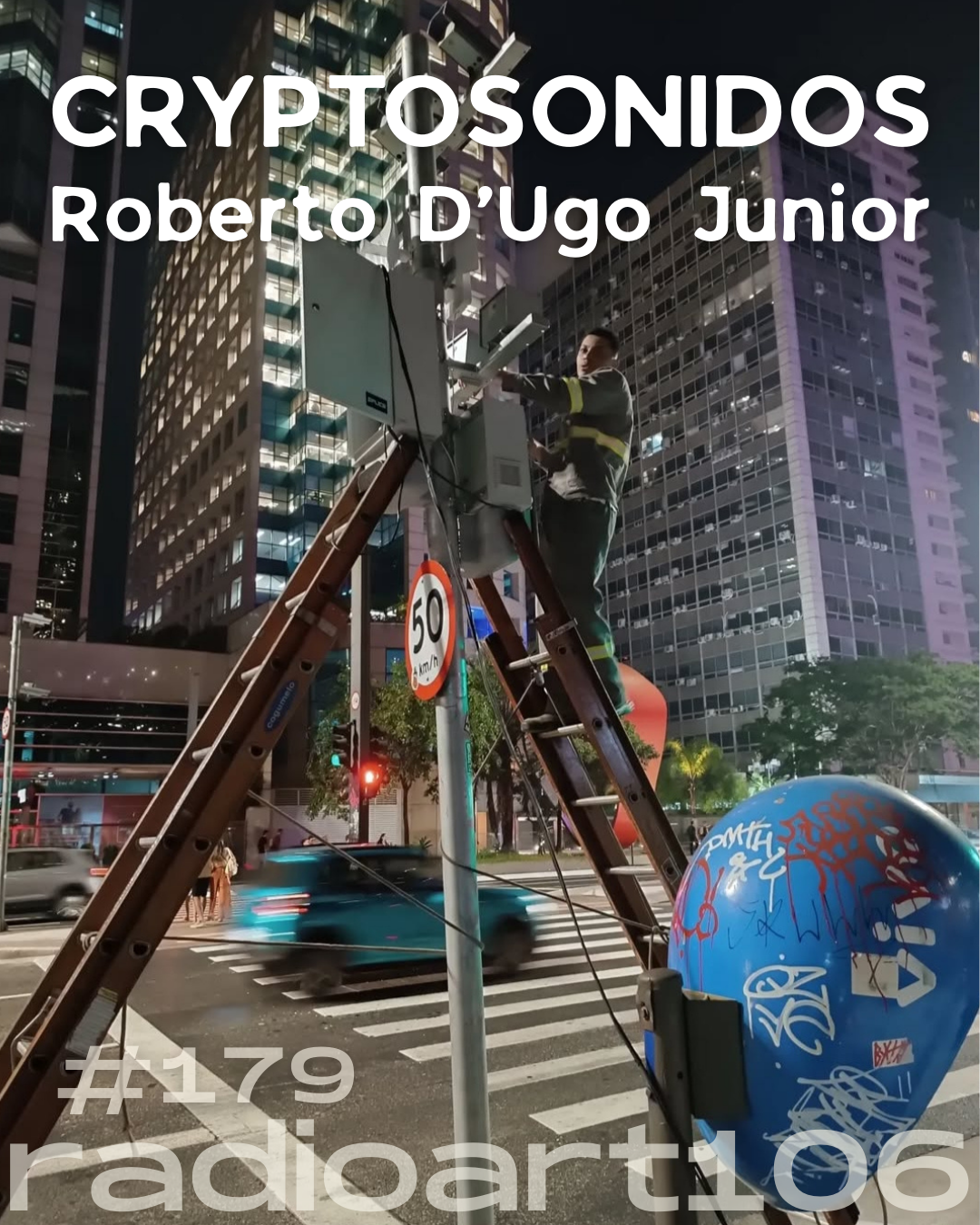
radioart106 #179 "CryptoSonidos" by Roberto D’Ugo Junior. Image by radioart106 (Oct 15, 2025)
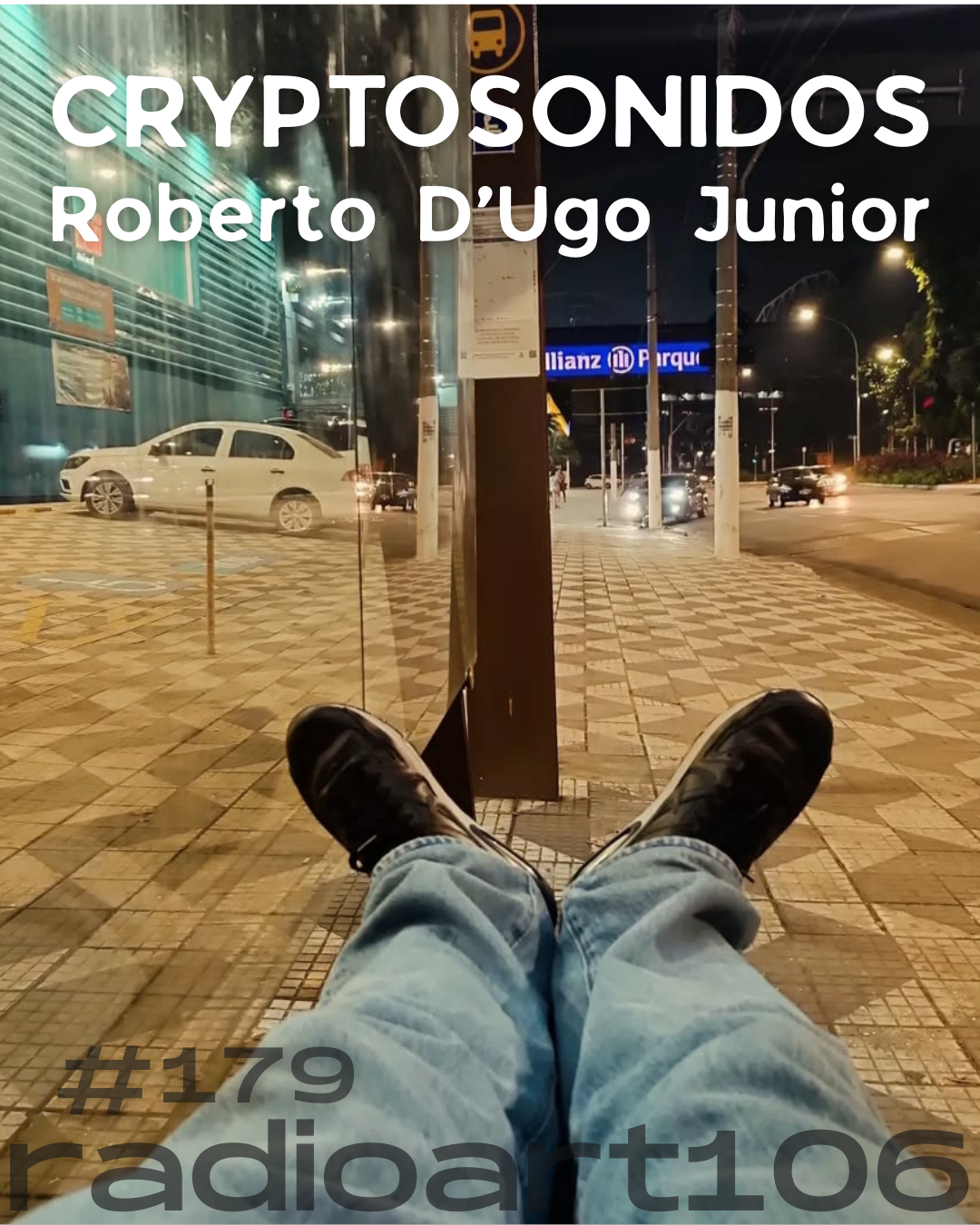
radioart106 #179 "CryptoSonidos" by Roberto D’Ugo Junior. Image by radioart106 (Oct 15, 2025)
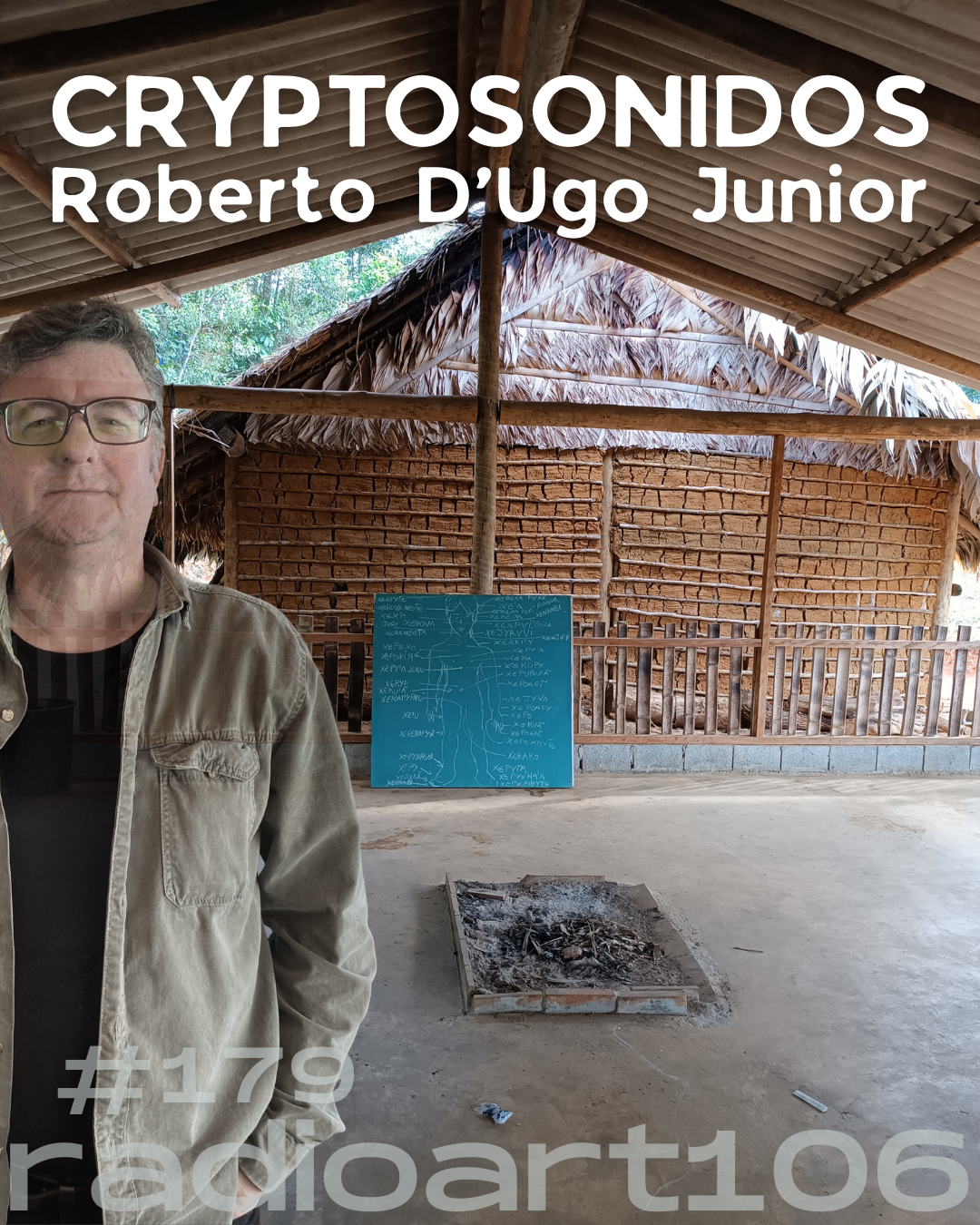
radioart106 #179 "CryptoSonidos" by Roberto D’Ugo Junior. Image by radioart106 (Oct 15, 2025)
radioart106 #179 "CryptoSonidos" by Roberto D’Ugo Junior. Image by radioart106
Produced and presented by Meira Asher.
radioart106 #179 "CryptoSonidos" by Roberto D’Ugo Junior
Roberto D'Ugo Junior is a brazilian artist-researcher dedicated to radio art. His work explores interfaces between magic, technique and art. Based on a poetic-documentary listening to everyday life, he develops an aesthetic investigation that dialogues with surrealism and musical minimalism. One of the main features of his work is the ritualistic repetition of speech residues and fragments of field recordings. He holds a PhD in Visual Arts from the Institute of Arts at São Paulo State University. He was programme and production coordinator at Rádio Cultura FM in São Paulo. He teaches radio and sound media at the Faculdade Cásper Líbero.
instagram.com/d_ugo_minimal_radio
soundcloud.com/user-48062083-271779683
Program Notes:
1. Objective Chance, 2020
Near the subway station, an encounter with the uncanny. “People we meet on the street... secretly devote themselves to black magic rituals.” Flânerie on Paulista Avenue, in São Paulo, after reading Umberto Eco. “This can never be fixed!” says the mother to the young woman in front of her. Latent meanings swirl on the sidewalk. Paranoia? The search for what lies beneath or beyond manifest reality. Repressed energy that emerges in waves, textures. I dissolve into the foam for a moment. Voice: Anna Carl Lucchese.
2. M.A.R. (Sea), 2019
Soundscape made from field recordings and loops extracted from the song Sereia do Mar (Seamermaid), by Brazilian female composer Babi de Oliveira (1908-1993). A game of marine images, reprocessed as if played by hesitant pianolas. An internal dive. Signs and calls to Yemanjá, waves of memory. The contemplation of a sunset to the sound of whistles from imaginary ships. Sound collage. Participating musicians: Giulia Grabert (piano); Tatiane Reis (soprano); Thiago Bernardes (tuba); Jefferson Silva (percussion). Piece created for the artistic performance A Arte de Navegar (The Art of Sailing), by Giulia Grabert, IA Unesp, São Paulo, 2019.
3. Misraim. How do you spell that, 2024
Maria Júlia and Deuzi are occasional fishermen. When sales of homemade coconut candies are not enough to put food on the table, the two siblings engage in subsistence fishing, one of the few ways to survive in Praia do Patacho, in Porto de Pedras, on the northern coast of Alagoas. They view the growth of tourism with some suspicion. Maria Júlia seems like a natural leader. She is 58 years old and Deuzi, her brother, is not much older or younger than her. They support each other, following the hard lesson they learned from their father: “Work, my son, work.” They remember the humble cassava plantation, the risky harvesting of coconuts from the tree, which cost their father an eye, and their sale at fairs in neighboring towns. In addition to the image of their mother's perseverance, they keep a touch of poetry in the strange combinations of sounds and letters in her name: “Misraim.” Maria Júlia seems unaware of any connection to the ancient Hebrews and Egyptians. Her mother's first name is a distinction, a small wonder. When Misraim had to be hospitalized, they asked Maria Júlia, “How do you spell it?” She spelled her mother's name with love and pride. “With my few letters, I said, make an M, an I, an S, then an R, an A, an I, and an M—Misraim, a beautiful name, right?”.
The piece is a poetic-documentary approach to the daily life of ordinary people, based on field recordings made with waist-high seawater on an afternoon in January 2023. It is an immersion in the vocality, emotions, and faith of Maria Júlia, achieved through electroacoustic processes, with the superimposition of sound textures extracted from her speech. Dilation, acceleration, and deceleration of a statement, beyond its semantic dimension. Mixing. The meaning of words emerges and submerges, leaving traces and dark marks, composing a somewhat disoriented and elliptical narrative. Ritornello. The unconscious as an acoustic experience. Dream or disconcerting manipulation by a demiurge? From concrete abstraction to film montage. From gesture to discourse. Only in the epilogue of the work does the story of the fisherwoman Maria Júlia appear in a more linear form, with the twinkling of the setting sun on the waves of the sea.
4. Welcome song, 2025
Field recording made in June 2025 inside the House of Prayer of the Aldeia Guarani Mbya Kalipety, in Parelheiros district, São Paulo – Brazil. Indigenous children's choir (48:09-51:25) Recorded in an indigenous village not far from the center of the metropolis of São Paulo. The Kalipety Indigenous Village is a Guarani Mbya community located in the Tenondé Porã Indigenous Territory, in the extreme south of the city of São Paulo, in the Parelheiros district. It is a place that preserves Guarani culture, serves as an agroecology center, and seeks to promote ethno-tourism, offering visitors an opportunity for cultural immersion and connection with nature. The village is a reference in agroecological practices, combining traditional Guarani knowledge with non-indigenous techniques for the recovery of degraded areas. Kalipety is open to ethno-tourism, seeking to reconnect non-indigenous people with nature and Guarani philosophy, breaking stereotypes about indigenous peoples. The village stands out for its leadership, driven by women such as Jera Guarani, who works to restore the land and create new villages.
5. CriptoSonido: Aleph (final section), 2020
CriptoSonido: Aleph has a dual nature: it is both a sound installation conceived within the realm of visual arts and an autonomous radio art piece in its acoustic poetics. Throughout the work, except for four enigmatic lines, Anna Carl Lucchese's voice is present, expressing itself basically through an inarticulate and denaturalized language, created by the editing and technical repetition (looping) of phonemes, breaths, laughter, and spasms, as well as the irregular and imprecise fragmentation of words and phrases transformed into “rhythmic utterances.” These enunciations rival or blend with the beats of a matraca (a rattle) and the rhythmic agitation of small rattles (“woodpecker”). The electroacoustic processing of these elements, in varying degrees of transformation, and their assembly and structuring into five or six sound panels, interspersed with pseudo-silences, make up the purely auditory dimension of the work. Perhaps a paradoxical and forceful affirmation of the effects of the presence of a mediatized voice charging headlong against logocentrism. Laughter and suffocation, breath and blow, Beckettian babbling: indices of an obliteration (physical, existential, semantic, musical?). Strange therapy. Perhaps a disconcerting attempt to contact the unknowable, a delayed resonance of the search for human meaning in the Mysteries of Creation. A surrealist vehicle, “magic for magic's sake, magic without hope,” as Jules Monnerot said.
Reflecting on the final minutes of CriptoSonido: Aleph, I think like Octavio Paz: “One must be in the secret. I say: be in it and not know it.” Particle acceleration is a good metaphor to describe the experience that the excerpt evokes. A young rabbi, after listening to the piece, alluded to a walk through the Tree of Life and mentioned the Merkava (heavenly chariot). I know little about ecstatic raptures. A forgotten surrealist spoke of “devoting oneself to the rites for their own sake, expecting nothing from them except the living experience that becomes one with the very act of performing these rites.” Vilém Flusser says something similar about Candomblé drums. I recognize the poet in these words. I recognize myself, headphones plugged in, rattling around the stereo recorder, shaking small maracas intensely, crouching, then stretching out, disinterested concentration, attempting the impossible, a Doppler effect perhaps, groping for timbres, creating and inventing at the same time, guided by an inner ear, finding myself in the cadence, like a shaman, forming something through sound. Voice: Anna Carl Lucchese.
radioart106 is an independent monthly Radioart program curated and produced by Meira Asher since 2014. radioart106 explores a wide spectrum of creative radio by worldwide radio artists.
Radioart is a subset of Soundart where Radioart is produced for/with the medium of radio and is specifically suited to be broadcasted on air waves. Radioart opens new ways and approaches to radio making, where the listener takes part whether through the intensity of the listening experience or sometimes through their active participation.
In 2025, radioart106 airs on USMARADIO, BernRaBe, reboot.fm, Radio Campus Paris, Radio Tsonami, P-Node, Diffusion919fm, and WGXC. radioart106 is affiliated with radia.fm.
Links:
instagram.com/radioart106
facebook.com/radioart106
x.com/radioart106
mixcloud.com/radioart106
patreon.com/radioart106